Factors Affecting Packers and Movers Charges: What Really Drives the Price
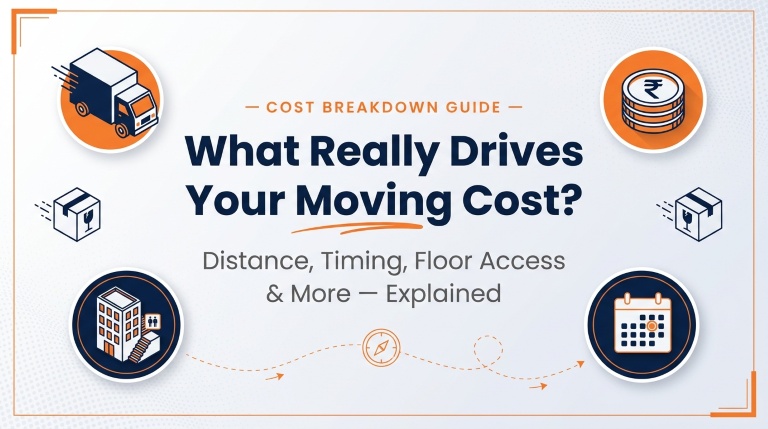
Two people moving the exact same 2BHK on the same day can get quotes ₹8,000 apart — not because one mover is greedy, but because of specific, identifiable variables in how the job is priced. Packers and movers charges are shaped by five main factors: distance and location, home and goods volume, timing, service level, and the provider you choose.
Based on patterns we've seen across thousands of moves booked through our platform, these five categories account for nearly all of the variation in a typical quote. If you're looking for exact price ranges by city and move type instead of the reasoning behind them, check our complete packers and movers charges guide.
1. Location-Based Factors
Distance as the Biggest Driver of Moving Costs
Every extra kilometer adds fuel cost, driver time, and toll expense, so a local move within the same city will almost always cost less than a domestic move across state lines, which in turn costs far less than an international relocation involving freight and customs. It's worth understanding this distinction upfront, since the pricing logic and the paperwork are genuinely different for each.
Floor Level and Lift Availability as a Cost Multiplier
On the ground floor, movers load straight from your door to the truck; add a few floors with no lift, and every box, piece of furniture, and appliance has to be carried up or down manually, which means more labor hours and often more people on the crew. This is why quotes for two identical homes can differ sharply based on floor access alone. If you're in a walk-up building, our guide on moving into an apartment without an elevator has practical tips to keep this cost from spiraling.

Remote or Hard-to-Reach Areas and Access Surcharges
Narrow lanes, gated communities with restricted entry, or areas simply far from the mover's usual routes reflect the extra time, smaller vehicles, or additional trips needed to actually get your goods to the door.
2. Home and Goods-Based Factors
Volume of Household Goods and Its Effect on Price
A 1BHK with minimal furniture will always cost less to move than a 4BHK packed with heavy furniture and appliances — not because of the home size itself, but because of what has to be packed, lifted, and transported. Decluttering before you book is genuinely one of the few factors you can control.
Fragile or Bulky Items and Extra Handling Costs
Glassware, artwork, electronics, and oversized furniture all need extra packing material, careful handling, and sometimes custom crating — all of which add to the bill. This isn't upselling; it's what keeps valuable items intact in transit.

Furniture Assembly and Disassembly as a Separate Charge
Beds, wardrobes, and modular furniture often need to be taken apart before transport and reassembled at the destination, since this requires extra time and sometimes a specific skill set — a bed frame is a different job from a modular wardrobe. Knowing this in advance means it won't come as a surprise addition to your final invoice.
3. Timing-Based Factors
Month-End and Weekend Moves and Their Premium Pricing
Movers see a predictable spike in demand around month-end and weekends, since that's when most leases turn over and most people are free from work — simple supply and demand, not a random markup.
Festival Season and Its Effect on Charges
Many people prefer to move around auspicious dates, while staff availability also drops as crews take time off. Booking outside these windows, even by a few days, can meaningfully lower your quote.
Advance Booking and Better Rates
Booking a mover with only a day or two's notice limits your options to whichever crew happens to be free, which weakens your negotiating position and often means paying a premium for availability.
4. Service-Level Factors
Dedicated Trucks vs Shared Trucks: The Cost Difference
For domestic moves, you can choose between a part-load truck, where your goods share space with other shipments, or a dedicated truck used only for your move. Part-load is cheaper because the cost is split across multiple customers, but it takes longer and involves more handling as goods are loaded and unloaded at multiple stops.

Full-Service Packing vs Self-Packing Costs
Letting the movers pack everything — materials, labor, and expertise included — costs more than packing your own boxes and only paying for loading, transport, and unloading, which also shifts the risk of damage claims onto how well you packed.
Storage and Insurance as Optional Add-On Costs
If there's a gap between move-out and move-in dates, short-term storage becomes a line item on top of the base quote. Insurance is a separate optional cost that protects the value of your goods in transit — more comprehensive coverage costs more but can be worth it for higher-value moves. Neither is mandatory, but skipping them shifts the entire risk onto you.
5. Provider-Based Factors
IBA-Approved Movers and Their Premium Pricing
Movers that are IBA (Indian Banks' Association) approved have gone through a verification process, which is exactly why they tend to charge more than an unverified local operator. That premium is effectively the cost of a paper trail and accountability if something goes wrong. You can compare profiles, ratings, and reviews across verified moving companies in India before deciding.
The Risk Behind Cheaper Quotes From Unverified Movers
It often means fewer safeguards, no fixed contract, and higher risk of last-minute price increases or damaged goods with no recourse. Before booking on price alone, it's worth learning how to verify a moving company's qualifications and spot common red flags.
Frequently Asked Questions
Conclusion
Your final packers and movers bill isn't a fixed number — it's shaped by where you're moving from and to, how much you own, when you choose to move, how much service you want, and which provider you pick. Understanding each of these factors means you can read any quote and know exactly what's driving the price, rather than just comparing bottom-line totals. If you're ready to move forward, get a free, no-obligation quote from verified movers near you.