Moving to Hyderabad: Cost of Living, Best Areas & Relocation Guide
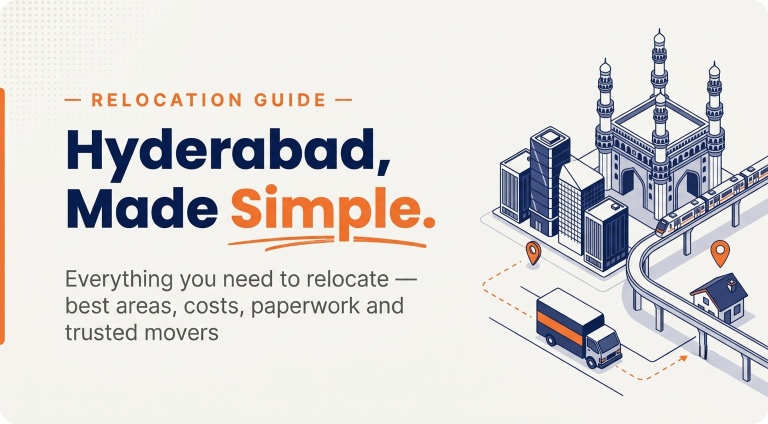
Moving to Hyderabad in 2026? The city pairs a 400-year-old Nizami heritage with India's second-largest IT hub, making it one of the most unique — and practical — metros to relocate to. This guide covers the cost of living in Hyderabad, the best areas to live, transport and commute, essential paperwork, and how to plan your move.
Hyderabad is actually two cities in one — Hyderabad and Secunderabad — and this twin-city layout affects where you should rent and how long your daily commute will be. We'll break that down below, along with how to hire trusted movers in Hyderabad for a smooth, stress-free relocation.
Jump to Section
Why People Move to Hyderabad
Most people move to Hyderabad for one reason: work. The city has earned the nickname "Cyberabad" for its rapidly expanding IT and ITES industry, and it now ranks as India's second-largest technology hub after Bangalore.
The major employment corridors are Hitech City, Gachibowli, and the Financial District, home to a dense cluster of Fortune 500 companies, global capability centers, and homegrown IT firms. Beyond software, Hyderabad has also built a strong presence in pharmaceuticals and biotechnology, anchored by Genome Valley — a distinction few other Indian cities can claim.
Add to this the twin-city structure of Hyderabad and Secunderabad, and you get a metro that offers big-city career opportunities without some of the infrastructure strain seen in other major hubs. Before you decide, it's worth weighing the full pros and cons of moving to Hyderabad.
Cost of Living in Hyderabad (2026)
Hyderabad remains one of the more affordable major metros in India, especially compared to Mumbai, Delhi NCR, and Bangalore — though costs have risen meaningfully in IT corridors over the past few years.
Estimated monthly cost, single person: ₹25,000 – ₹40,000
Estimated monthly cost, family of four: ₹55,000 – ₹90,000
| Expense Category | Single Person (Monthly) | Family of Four (Monthly) |
|---|---|---|
| Rent | ₹10,000 – ₹25,000 | ₹20,000 – ₹45,000 |
| Utilities (electricity, water, gas) | ₹1,500 – ₹3,500 | ₹3,000 – ₹6,000 |
| Food & Groceries | ₹5,000 – ₹10,000 | ₹12,000 – ₹20,000 |
| Commute | ₹1,500 – ₹4,000 | ₹3,000 – ₹6,000 |
| Entertainment & Leisure | ₹3,000 – ₹7,000 | ₹5,000 – ₹10,000 |
| Miscellaneous | ₹2,500 – ₹5,000 | ₹4,000 – ₹8,000 |
| Total | ₹25,000 – ₹40,000 | ₹55,000 – ₹90,000 |
Best Areas to Live in Hyderabad
Where you should live depends heavily on why you're moving — the right locality for a single IT professional looks very different from the right one for a family with school-age kids.
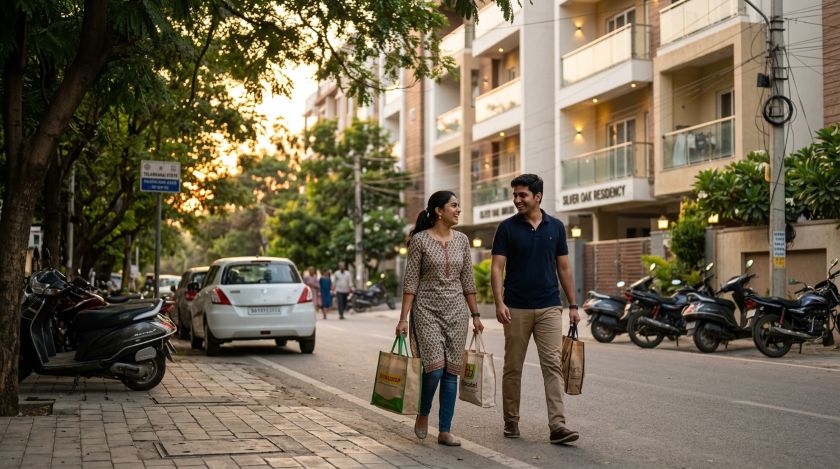
Best Localities for IT Employees & Job Seekers
- Hitech City – closest to the tech corridor, high rental demand
- Gachibowli – major IT and corporate campuses, growing social infrastructure
- Kondapur – slightly more affordable, good connectivity to Hitech City
- Madhapur – young-professional hub, close to nightlife and co-working spaces
- Financial District – newer, upscale, near several corporate parks
Best Localities for Families
- Banjara Hills – upscale, established, close to top schools and hospitals
- Jubilee Hills – premium residential area, strong social infrastructure
- Kukatpally – more affordable, well-connected via metro
- Miyapur – growing family-friendly suburb, metro-connected
- Secunderabad – older, well-established, strong connectivity via rail and road
Things to Check Before Renting
Utilities Setup: Water, Power, Gas, Internet
Setting up utilities in Hyderabad typically takes a few days once your rental agreement is in place. Here's what to expect:
- Water — Supplied through the Hyderabad Metropolitan Water Supply and Sewerage Board (HMWSSB). In newer or peripheral localities, buildings may rely partly or fully on borewell water — confirm this before renting.
- Electricity — Managed by TGSPDCL (Telangana State Southern Power Distribution Company). New connections or name transfers can usually be completed online.
- LPG Gas — Book a connection through major providers (Indane, HP, Bharat Gas); most housing societies have an empanelled distributor.
- Internet & Mobile — Major ISPs (ACT Fibernet, Airtel, Jio) offer strong coverage in IT corridors; check building-specific availability before committing to a plan.
Documentation and Paperwork After Moving
A few administrative steps are non-negotiable after you move — skipping them can cause issues later with utilities, banking, or renewals.
Is Hyderabad Safe to Live In?
Hyderabad is generally regarded as one of the safer major metros in India, including for solo movers and families.
Getting Around: Transport and Traffic in Hyderabad
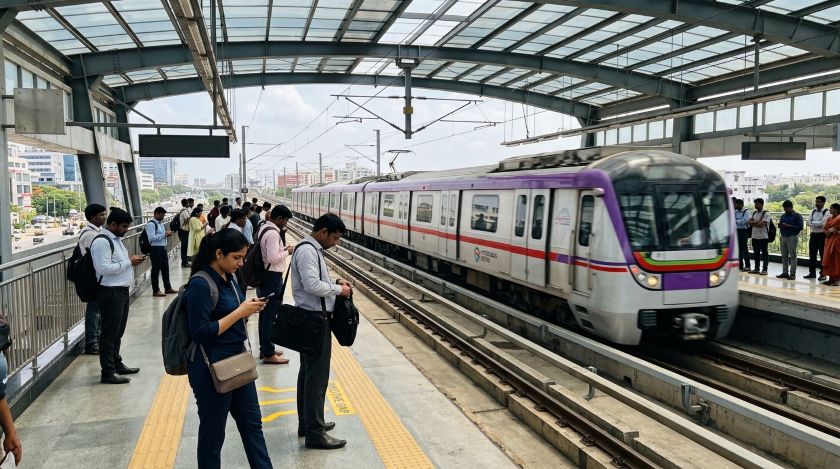
Public Transport
Hyderabad Metro — Covers three main corridors: the Red Line (Miyapur–LB Nagar), Blue Line (Nagole–Raidurg, serving the IT corridor), and Green Line (JBS–MGBS). The Blue Line is especially useful for commuters working in Hitech City and Gachibowli.
Pushpak AC Buses — Dedicated airport buses connecting the city to Rajiv Gandhi International Airport.
TSRTC Buses — City-wide bus network; useful but timing can be inconsistent outside major routes.
Auto-Rickshaws & Ride-Hailing
Auto-rickshaws in Hyderabad frequently skip the meter, so confirming the fare before starting your ride is standard practice. For predictable pricing, Ola, Uber, and Rapido are widely available — Rapido tends to be the most economical of the three for short trips.
Traffic Hotspots and Peak Hours
Airport Connectivity
Rajiv Gandhi International Airport (Shamshabad) sits well outside the city center. Road travel time ranges from 45 minutes to over an hour depending on traffic and starting point. Pushpak AC buses connect the airport to major parts of the city; there is currently no direct metro link to the airport.
Arriving in Hyderabad by Train or Bus — and Planning Your Move
By Train
Hyderabad is served by three major stations: Secunderabad Junction (the largest and best-connected), Hyderabad Deccan (Nampally), and Kacheguda. Which one you arrive at often depends on your route of origin — check your ticket carefully, as the three stations are spread across the twin cities.
By Bus
TSRTC and interstate private operators run frequent services into Hyderabad from across South and Central India, with major arrival points located across the city depending on direction of travel.
Household Moving and Hyderabad Moving Charges
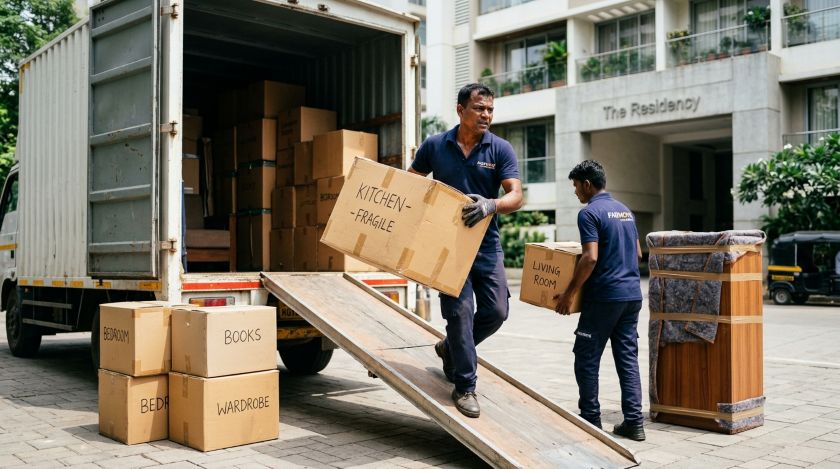
If you're relocating your entire household rather than arriving with just luggage, hiring a professional moving company is almost always more reliable — and often more cost-effective — than a DIY move once you factor in transport, packing materials, and potential damage.
Typical Hyderabad moving charges depend on your move type:
- Local move (within Hyderabad): ₹4,000 – ₹15,000, depending on household size
- Intercity/interstate move: ₹8,000 – ₹40,000+, depending on distance and volume
Healthcare in Hyderabad
Hyderabad has strong private healthcare infrastructure, with well-known chains including Apollo, Yashoda, KIMS, and Continental Hospitals operating multiple facilities across the city. Most IT and corporate employers provide health insurance coverage — confirm your policy's network hospitals as part of your onboarding.
Language and Culture: What to Know Before You Move
Telugu is the official and majority language of Hyderabad and Telangana. A large portion of the population also speaks Urdu — specifically Hyderabadi Urdu, a distinct dialect with its own vocabulary and rhythm, different from standard Urdu spoken elsewhere. Hindi is widely understood, and English is the default language in most corporate and professional settings, so newcomers from other states typically adjust quickly.
Hyderabad's culture carries a strong Nizami influence — visible in its architecture, food, and everyday etiquette — layered onto a broader South Indian, Deccan identity.
Settling In: Food and Local Life
Hyderabadi cuisine is a distinctive fusion of South Indian, Mughlai, and North Indian influences, and it's one of the city's genuine everyday pleasures. Signature dishes worth trying early on include Hyderabadi Biriyani, Haleem (especially during Ramadan), Pappu (a tangy lentil dish), and Mirch ka Salan. Andhra and Hyderabadi food can run spicier than what newcomers from North India are used to, so it's worth asking about spice levels when ordering.
Eating out is generally affordable relative to other metros, which helps keep day-to-day food costs manageable even for those who cook infrequently.
Weather and Climate: What to Expect
Hyderabad has hot summers, pleasant winters, and a monsoon season influenced by cyclonic depressions in the Bay of Bengal, which can bring irregular rainfall spikes through the year.
- Summer (March–June): Hot and dry, temperatures often exceeding 38–40°C
- Monsoon (June–September): Moderate to heavy rainfall, occasional cyclonic influence
- Winter (November–February): Mild and pleasant, the most comfortable stretch of the year
Education: Schools and Colleges
Families relocating mid-academic-year should start school admission inquiries early, as availability can be limited outside the standard admission cycle — many schools maintain waitlists specifically for relocating families.
Hyderabad is also home to several notable higher-education institutions, including the Indian School of Business (ISB), IIIT-Hyderabad, the University of Hyderabad, and Osmania University — relevant if you're relocating with older children or considering the city for higher education.
Frequently Asked Questions
Conclusion
Moving to Hyderabad comes down to a handful of practical decisions: choosing the right locality for your situation — whether that's the IT corridor for career convenience or a family-friendly suburb for schools and space — budgeting for the city's higher security deposit norms, setting up utilities and paperwork early, and timing your move to avoid the monsoon season where possible. Handle these well, and Hyderabad offers one of the more balanced combinations of affordability, career opportunity, and quality of life among India's major metros.
Choose the right locality
Set up utilities correctly
Complete mandatory paperwork
Plan around traffic and monsoon
Hire trusted movers in Hyderabad through AssureShift