How to Move Your Shop or Showroom: Complete Relocation Guide
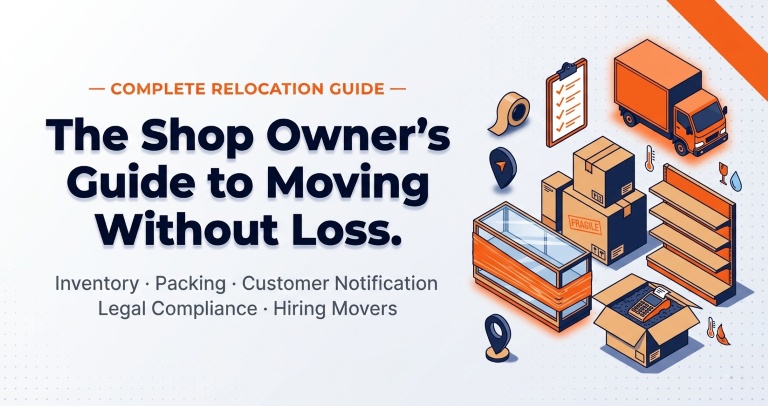
Every rupee of revenue you lose during a shop relocation could have been saved with one thing: a plan. Shop relocation is not a larger version of shifting your home — it involves live inventory that can be damaged or lost, customers who may never return if they find your shutters down without notice, and compliance paperwork with real deadlines. Every single disruption is avoidable with the right approach.
This guide is written specifically for Indian shop and showroom owners who need a practical, step-by-step approach to commercial relocation — covering shop shifting planning, inventory management, customer notification, packing, legal compliance, and hiring the right commercial movers. By the time you finish reading, you will know exactly what to do, when to do it, and what it costs if you skip any of it.
Plan Your Shop Relocation Well in Advance
Poor planning is the single biggest reason shop owners lose money during a move — not damaged goods, not bad movers. Just the absence of a clear timeline.
For a small retail shop, allow a minimum of 6–8 weeks from decision to move-in day. For a large showroom with heavy fixtures, display systems, and significant stock, plan for 3–6 months. Your timeline must work backwards from two fixed points: your lease end date at the current location and your new location's readiness date. Everything else — packing, notifications, mover booking — is built around these two anchors.
Shop Relocation Master Checklist
Use this as your week-by-week roadmap:
Audit and Manage Your Inventory Before the Move
Inventory loss and misplacement during a shop move is far more common than damage — and far harder to claim. The solution is a structured inventory process that begins at least 4 weeks before moving day.
Follow this 4-step system:
Create a complete itemized list of all stock, fixtures, equipment, and display units. Include quantities and estimated values. This is your baseline for insurance purposes and for cross-checking after the move.
Photograph every high-value item — display cases, electronics, billing machines, CCTV equipment, branded fixtures, and any fragile merchandise. Store these photos in a cloud folder with dates. If something is damaged in transit, this is your evidence.

The less you move, the lower your transport quote. Before the move, run a clearance sale on slow-moving or seasonal stock. Return excess goods to suppliers where possible. Consider B2B liquidation for bulk items you cannot sell at retail. Less volume in the truck means a lighter quote and faster setup at the new location.
Every packed box must carry three pieces of information: what is inside (by category, not item-by-item), where it goes in the new shop, and whether it is fragile.
Choose the Right Time to Relocate Your Shop
Timing a shop relocation correctly can mean the difference between a smooth three-day transition and a two-week revenue gap.
Avoid These Windows Entirely
| Period | Why to Avoid |
|---|---|
| Festive season (Sep–Nov: Diwali, Navratri, Dussehra) | Peak revenue period — missing this means losing your highest footfall months |
| Monsoon (June–September) | Goods-damage risk from wet loading bays, open trucks, and rain delays |
| Month-end and March (financial year-end) | High transaction volumes, GST filing pressure, and staff overload |
Best Windows to Target
- January–February: Post-festive slowdown, good mover availability, low footfall pressure
- May (before monsoon onset): Predictable weather, moderate business activity
- Weekday mornings: Movers work faster, roads are manageable, you avoid weekend customer confusion
Pack Your Shop and Showroom Items the Right Way
This is the step most shop owners underestimate, and it is where the most damage occurs. Packing a showroom is fundamentally different from packing a home. You are dealing with display units designed for aesthetics — not portability — and goods whose condition directly affects your ability to sell.
Pack items based on category to avoid damage:
| Item Type | Packing Method | Special Notes |
|---|---|---|
| Regular stock & merchandise | Double-walled carton boxes | Don't overload — commercial goods split boxes at the base |
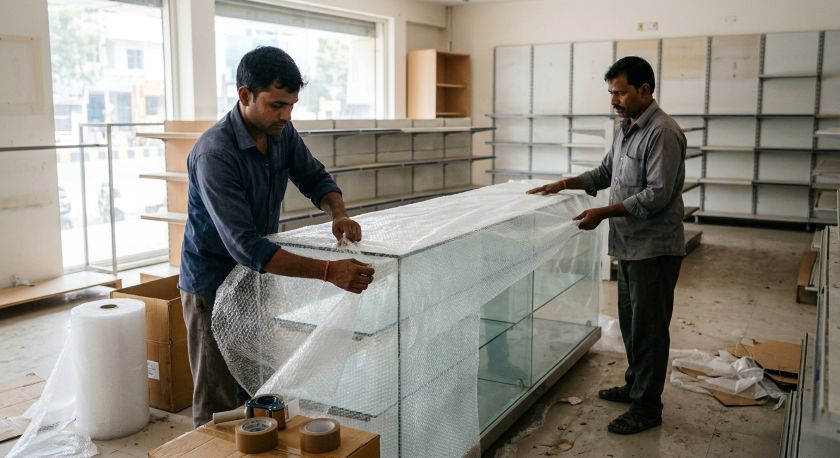
| Fragile & glass items | Bubble wrap + double-boxing | Mark all surfaces as fragile; disassemble packing fragile display units glass counters |
| Electronics (billing, POS, CCTV) | Foam-lined cartons + anti-static material | Use original boxes if available; back up all data first |
| Display fixtures & heavy furniture | Dismantle, wrap each component separately | Keep bolts/screws in labelled ziplock bags taped to each part |
| High-value goods (jewellery, luxury items) | Document individually with photos + serial numbers | Consider carrying these yourself; ask mover about individual insurance |
- What is inside?
- Where does it go in the new shop?
- Is it fragile?
Notify Your Customers, Vendors, and Platforms
This is the most business-critical section of your relocation plan. A customer who arrives at your old address and finds an empty shop does not automatically follow you to the new one. You must proactively reach every channel your customers use to find you.
Start with Your Customers First
Begin notifications at least 3–4 weeks before your moving date.
- In-store signage: Put up a clear notice at the current shop with your new address, moving date, and a QR code linking to Google Maps. Keep it up until you vacate.
- WhatsApp broadcast: The most effective and lowest-cost notification tool for Indian retail. Send at least two messages — one 3 weeks before and one 2–3 days before the move.
- SMS and social media: Send an SMS blast if you have customer numbers. Post on Instagram and Facebook with the new address, a map, and a short reel or graphic. Tag your new location.
- After the move: If your landlord permits, leave a redirect notice at the old address for 2–4 weeks. A simple "We have moved to [new address] — 2 km away" retains a significant number of walk-in customers.
Next, Inform Your Suppliers and Vendors
Update your delivery address with every supplier at least 2 weeks before the move. Confirm the first delivery to the new address is successfully routed before moving day — a misdelivered wholesale order can disrupt your entire setup schedule. Also update payment and invoice address details to avoid GST mismatches.
Finally, Update Every Online Platform
This step directly affects your visibility in local search — which is how most new customers find you.
- Google Business Profile: Update your address immediately. Your local search ranking is tied to the accuracy of this listing. Incorrect address = customers going to the wrong location = lost footfall.
- Justdial, Sulekha, IndiaMart: Update all active listings — these platforms drive significant walk-in and call traffic for Indian retailers.
- Your website: Update the contact page, the footer address, and the embedded Google Maps link.
- Social media bios: Update your location tag on Instagram, Facebook, and any other active platform.
- E-commerce seller accounts: If you sell on Meesho, Amazon, Flipkart, or any marketplace, update your registered address and pickup location immediately to avoid order fulfilment errors.
Hire the Right Commercial Moving Company for Your Shop
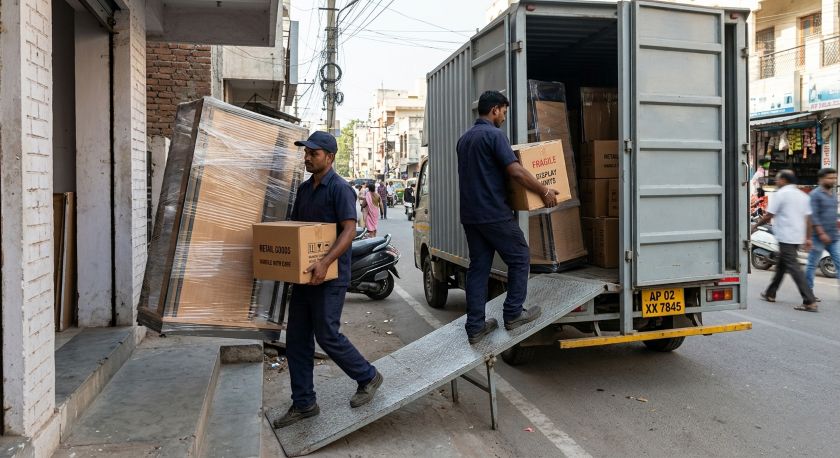
A shop or showroom move is not a job for general tempo hire or daily labour. The goods involved — glass display cases, electronics, heavy fixtures, live inventory — require proper packing, material, trained handling, and the right vehicle configuration. Professional showroom shifting services are equipped to handle all of this systematically.
What a Reliable Commercial Mover Must Offer
- Demonstrable experience with retail or commercial moves (ask for references)
- Proper packing materials: bubble wrap, double-walled cartons, stretch film, wooden crating for fragile items
- The right vehicle size for your volume — an undersized truck means two trips and double the risk
- Goods-in-transit insurance, either included or available as an add-on
- A written agreement specifying scope, timelines, and liability
- A GST invoice — movers who cannot provide one are unregistered and carry no legal accountability
Questions to Ask Before You Book
- Have you handled shop or showroom moves before? Can you share references?
- Do you provide packing materials and packing services, or is that separate?
- Is goods-in-transit insurance included in the quote or available as an add-on?
- What is your specific process for fragile display units and glass items?
- Will you provide a written agreement and a GST invoice?
Red Flags — Walk Away If You See These
Compare verified commercial movers and get free quotes on AssureShift before you make a decision.
Frequently Asked Questions About Shop and Showroom Relocation
Final Thoughts on Relocating Your Shop or Showroom
Shop relocation is a genuinely complex operation — and acknowledging that is the first step to handling it well. The difference between a move that costs you customers and a move that costs you only a few days of downtime comes down entirely to how early you planned and how carefully you chose the team around you.
Your new location is not just a logistical endpoint — it is an opportunity. A better address, a bigger space, a fresh start for your business.
Ready to shift your shop? Get free quotes from verified commercial movers on AssureShift and move with confidence.