Most homebuyers spend weeks shortlisting properties — comparing locations, floor plans, and price per sq ft. But when it comes to actually inspecting the flat Before signing, also go through the key questions to ask your landlord before renting — small clarifications upfront prevent most disputes later.
This checklist covers every critical area room by room — walls, plumbing, electrical, legal documents, and more — so you know exactly what to look for before you sign anything. Whether you are buying in Bangalore, renting in Pune, or taking possession in Mumbai, use this as your walkthrough companion.
1. Walls & Ceilings
Cracks and moisture in walls are rarely cosmetic — they are usually symptoms of a deeper structural or waterproofing problem underneath.
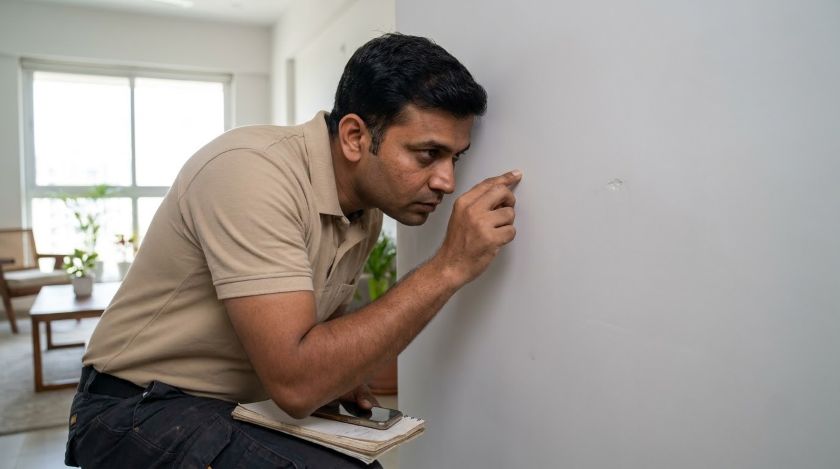
![Inspector knocking on apartment wall with knuckle to detect hollow plaster before possession]() Knock across the full wall surface — a hollow sound reveals plaster that has separated from the base
Knock across the full wall surface — a hollow sound reveals plaster that has separated from the base
Cracks — Hairline cracks on flat surfaces are generally minor. Diagonal cracks running from the corners of doors or windows, or wide cracks with displacement, are worth flagging to a structural professional before possession.
Plaster condition — Knock the wall with your knuckle. A hollow sound means the plaster has separated from the surface beneath and will eventually fall.
Water stains or damp patches — Note their position. Are they below a bathroom above, near a window, or on an exterior wall? Location tells you the source.
Efflorescence — White powdery deposits on walls mean moisture is migrating through from behind.
Damp Proof Course (DPC) — Check the wall-floor junction at the base of exterior walls for rising dampness.
Paint condition — Bubbling or peeling paint means moisture is trapped beneath the surface, not just on it.
Red Flag: Wide or displaced cracks at door and window corners are worth getting a professional opinion on before possession — do not accept them as routine finishing issues without checking.
Mumbai & Chennai: Efflorescence is especially common on exterior-facing walls due to salt-laden coastal humidity. Spend extra time on these.
2. Flooring
Flooring issues go beyond aesthetics — hollow tiles crack under regular use, and a poorly sloped bathroom floor causes waterlogging every single day.
Hollow tile test — Knock each tile firmly with your knuckle. A hollow sound means it is not properly bonded to the base and will crack under load.
Bathroom floor slope — Pour a small amount of water and watch where it goes. It must drain toward the floor trap — not pool near the walls or door.
Tile levelness — Walk slowly across every tiled surface. Noticeable unevenness underfoot or visible lips between adjacent tiles are a tripping hazard and worth flagging.
Anti-skid surface — Wet your palm and press it on bathroom and kitchen tiles. If it slides easily, those tiles are a safety risk.
Grout lines — Cracked or absent grout is an open channel for moisture to reach beneath the tile layer.
Room thresholds — Uneven joins where one floor type meets another are a common trip point — check every transition.
Wooden or laminate floors — Walk slowly across them. Squeaking, visible edge swelling, or gaps between planks need attention.
Red Flag: Hollow tiles near any plumbing-exposed area — bathroom floor, under the kitchen sink — are urgent. Water gets under the tile, sits against the slab, and causes damage you will not see until it is very expensive.
3. Plumbing & Water Supply
Plumbing problems are the most common post-move-in complaint in Indian homes — and almost all of them show signs during inspection if you look properly.
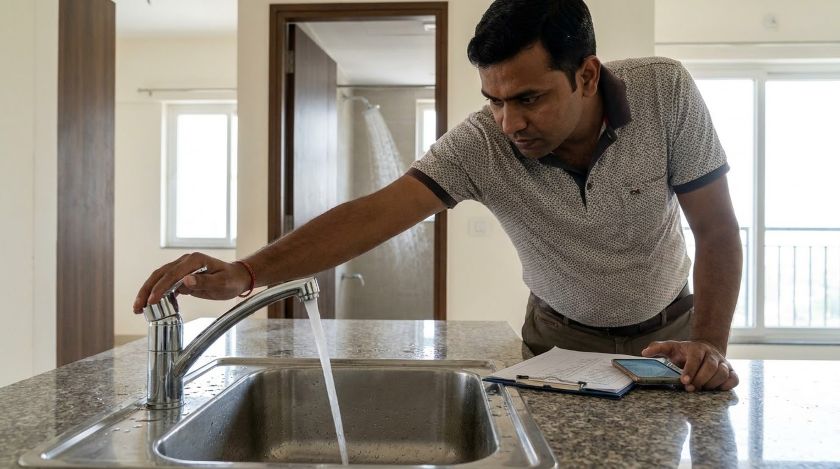
![Buyer turning on multiple taps at the same time to test water pressure in a new apartment]() Run every tap simultaneously — weak pressure across multiple points means a building-level supply problem
Run every tap simultaneously — weak pressure across multiple points means a building-level supply problem
Water pressure test — Turn on every tap and shower simultaneously. Weak pressure at multiple points signals a supply line issue at building level.
Concealed pipe check — Look for damp patches or discolouration on walls adjacent to known pipe runs — behind the bathroom wall, under the kitchen counter.
All taps and valves — Open and close every inlet and outlet valve fully. Stiff or stuck valves mean corrosion or long disuse.
Drainage clearance — Pour water into every drain and time it. Slow drainage means a blockage — construction debris is a frequent culprit in new homes.
WC and flush — Check the cistern fill level, flush force, and seat stability. A weak flush usually means a faulty valve.
Water source — Ask directly: municipal supply, borewell, or tanker? What is the backup if the primary source fails?
Overhead tank — Confirm its capacity, condition of the lid, and whether it is practically accessible for periodic cleaning.
Red Flag: Test water pressure in the morning between 7–9 AM, not mid-afternoon. Pressure issues that appear only at peak hours are a building-level problem — not something the builder will fix easily.
Bangalore & Hyderabad: Tanker dependency during summer months is common in many apartment complexes. Confirm the building's water source and backup arrangement before you commit.
4. Electrical Fixtures & Safety
Electrical defects are invisible until they cause harm. Every outlet, switch, and safety device deserves a deliberate check — and for older or resale properties, it is worth understanding why hiring an electrician before moving in can save you from serious safety risks.
Earthing connection — Verify at every outlet, especially in the kitchen and bathroom. A missing earth is a silent electrocution risk.
MCB and ELCB — Both must be present, correctly labelled, and functional. Ask the builder to trip-test them in front of you.
Buzzing or crackling near switches — Indicates loose wiring or internal arcing. Do not dismiss it as a new-building quirk.
Every switch and outlet — Test each one. A plug-in socket tester (available for under ₹200 online) makes this fast and accurate.
Circuit distribution — Confirm separate circuits for AC units, kitchen appliances, and general load. Combined circuits trip constantly.
Outlet placement — Check near the bed wall, TV wall, kitchen counter, and study area. Insufficient points become a permanent inconvenience.
AC provision — Confirm mounting wall, outdoor unit placement space, and drainage pipe routing are accounted for.
Red Flag: A non-functional earth connection must be fixed before a single appliance is plugged in. No negotiation on this one.
5. Doors
Doors handle your home's security and privacy every single day — a weak lock or misaligned frame is not a minor issue.
Frame alignment — Hold a spirit level against the door frame. A frame that is out of plumb indicates settlement or poor installation.
Main door security — Test the lock quality, deadbolt operation, door closer, peephole, and chain lock. All must work smoothly.
Wooden frames and shutters — Inspect closely for termite mud channels along the surface, sapwood, warping, or spots that feel unusually soft when pressed.
Interior door operation — Every door must open and close fully without dragging on the floor or binding at the frame.
Hinges and knobs — Check for play, squeaking, or loose fixing at each hinge.
Bathroom and main door frames — Confirm waterproof adhesive was used. Standard wood adhesive swells and fails quickly with moisture exposure.
Red Flag: A door frame visibly leaning or twisted usually means the wall behind it has moved. This is a structural signal — treat it as one.
6. Windows
Windows are your first line of defence against rain, noise, and insects — gaps or broken seals create compounding problems with every monsoon.
Frame-to-wall seal — Run your finger around the join between the window frame and the wall opening. Any gap is a rain entry point.
Locking mechanism — Every window latch and lock must operate cleanly. A lock that does not fully engage is a security gap.
Gasket seal — Check the rubber or foam seal around the frame. Dried or cracked gaskets allow both water and outside noise to come in.
Safety grills — On upper floors especially, visually check the fixing points at the wall anchors and look for rust, loose screws, or visible gaps in the frame.
Mosquito mesh — Must be present, fully intact, and fitted flush without gaps at the edges.
Frame alignment — No visible twisting or warping; the window should open and close without binding.
Ventilation direction — At least one window in every room should open toward external fresh air, not an internal shaft or dead wall.
Red Flag: An unsealed gap between a window frame and wall is one of the most common causes of interior wall staining during monsoon — and the easiest to miss on a dry summer day. Run your hand along every frame.
7. Kitchen
The kitchen takes more daily abuse than any other room — inspection here is about safety and function, not just finish quality.
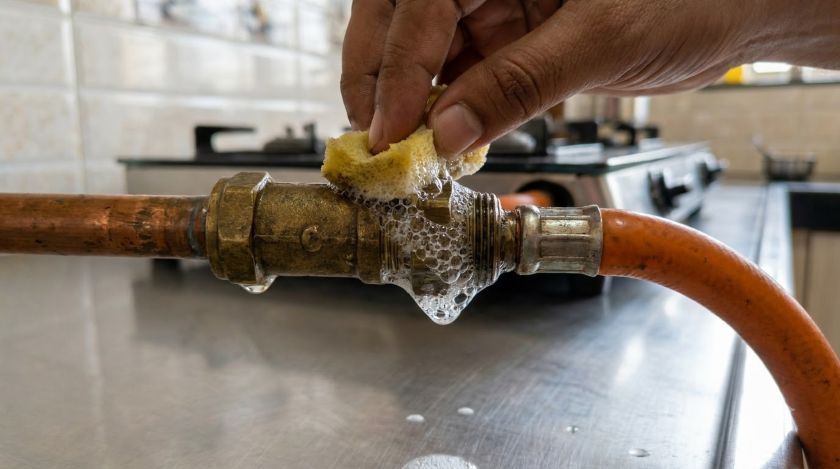
![Soapy water applied to kitchen gas pipe joint showing bubbles that signal an active leak]() Apply soapy water to every gas joint — bubbles forming means stop and report immediately
Apply soapy water to every gas joint — bubbles forming means stop and report immediately
Exhaust fan or chimney provision — This is non-negotiable. A kitchen with no ventilation path traps heat, moisture, and cooking grease permanently.
Gas pipeline or LPG point — Apply soapy water to every joint. Bubbles forming = active gas leak. Stop and report immediately.
Counter-level electrical outlets — Verify sufficient points within reach of the cooking and prep area for appliances.
Platform and countertop — Check for chips, rough cut edges, and run a level across the full length. An uneven counter causes permanent frustration.
Kitchen sink — Test drainage slope, tap alignment, and confirm the overflow drain is clear and functional.
Kitchen fittings and cabinets — Open and close every shutter and drawer. Check hinge tension, drawer runner smoothness, and edge banding on all exposed boards.
Under-sink cabinet — Always open this. Inspect for existing moisture stains, mold, or gaps that allow pest entry.
Tile splash-back — Should be fully grouted and heat-resistant behind the cooking area.
Red Flag: A missing exhaust or chimney provision is not a cosmetic gap — it causes persistent ceiling moisture, grease accumulation, and eventual cabinet and plaster damage.
8. Bathrooms
Bathrooms are the most water-exposed rooms in any home. A waterproofing failure here does not stay in the bathroom — it travels into adjacent walls and the ceiling of the unit below.
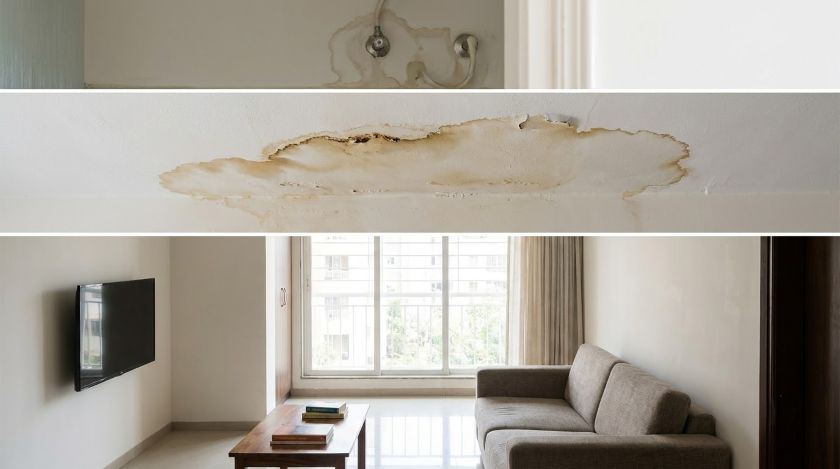
![Brown water stain on ceiling of room below bathroom indicating waterproofing failure above]() Check the ceiling of the room directly below the bathroom — staining here is the clearest waterproofing signal
Check the ceiling of the room directly below the bathroom — staining here is the clearest waterproofing signal
Wall-floor junction — Inspect the base of every bathroom wall for staining, damp patches, or white salt deposits. These mean water is getting through.
Ceiling of the room directly below — This is your most reliable indicator. Any staining on that ceiling means the bathroom above has a waterproofing problem.
Floor anti-skid — Wet the tiles and test grip with your foot. Slippery bathroom floors are a daily injury risk.
Exhaust fan — Must be operational and venting outward — not blowing humid air into a ceiling cavity.
WC and flush cistern — Check water fill level, flush force, and that the seat is firmly fixed.
Geyser point — Correct installation height, and adequate distance from any direct water source.
Shower — Test pressure and confirm the floor drain is correctly positioned to catch the flow.
Red Flag: Waterproofing failure is the single most expensive bathroom repair. It almost never shows clearly inside the bathroom itself — check the ceiling below.
9. Roof & Terrace
The roof and terrace are the first line of defence against rain. Their condition determines the condition of every ceiling and wall underneath.
Terrace surface — Walk the full terrace and check for cracks, blistering, or areas where the waterproof membrane is peeling.
Standing water marks — Tide marks or discolouration on the terrace surface indicate that water pools here instead of draining.
Terrace drainage slope — Water must run toward the outlet drains — not toward the parapet walls or sit in the centre.
Parapet wall — Check that height is adequate and look for visible cracks, crumbling mortar, or sections that appear loose or misaligned.
Overhead tank — Inspect material condition, lid integrity, and whether cleaning access is practically usable.
Expansion joints — Should be present between structural elements and filled cleanly — open or cracked joints allow water ingress.
Red Flag: Terrace waterproofing failure is a common and serious cause of interior ceiling damage — and it typically shows no warning signs from inside until the first heavy rain arrives.
Kolkata, Kochi & Mumbai: A single monsoon season can expose years of deferred terrace maintenance. Do not skip this inspection even if the flat looks perfect from inside.
10. Balcony & Exterior
Balconies face weather exposure year-round — issues here are routinely missed because buyers focus on the interior during their visit.
Railing condition — Visually check for rust, loose fixings at the base, missing balusters, or any visible gaps at wall anchor points. Any visible instability is a safety concern to report before possession.
Interior wall behind the balcony door — Staining or damp patches on this wall mean balcony drainage or waterproofing has already failed.
Balcony floor slope — Water must drain outward toward the edge — not back into the main room.
Wall-floor junction on the balcony — Check for staining or salt deposits at the base of the balcony walls.
External wall condition — Step outside or look at the building elevation. Spalling plaster, visible cracks, or rust staining from reinforcement bars are serious concerns.
Safety grills or nets — Check fixing strength at wall anchors — not just whether they are present.
Red Flag: Any visible looseness, rust, or missing fixings on a balcony railing is a safety concern — report it to the builder or owner in writing before possession.
11. Carpet Area & Room Dimensions
You are about to pay for a specific floor area — spend 15 minutes confirming you are actually getting it.
First, understand the three terms:
| Term |
What It Means |
|---|
| Carpet Area |
Under RERA, this is the net usable floor area within the walls of your flat — including internal partition walls but excluding external walls, balconies, terraces, and common areas. |
| Built-up Area |
Carpet area + the thickness of external and internal walls. |
| Super Built-up Area |
Built-up area + your proportional share of common spaces such as lobby, lifts, and stairwells. |
Under RERA, every sale agreement must state the carpet area as defined above. This is your legal reference point — not the brochure figure, and not the super built-up area figure often quoted in marketing.
Carry a tape measure and physically measure length × width of every room.
Compare your figures against the RERA registration document — any shortfall should be raised with the builder formally before registration.
Include dry balcony, utility area, and any storage lofts in your total calculation.
If there is a meaningful difference between what you measure and what was agreed, consult a legal advisor before signing.
Red Flag: Any significant shortfall in carpet area against the registered figure is a legal matter, not just a negotiation point — get clarity before signing the sale deed.
12. Legal & Documentation
A physically perfect flat with a documentation deficiency is still a risk — legal complications surface at resale, loan application, or during disputes with the builder.
![Flat ownership documents including occupancy certificate and RERA registration laid out on a desk for review]() Verify RERA registration independently on your state's official portal — never rely only on builder-supplied paperwork
Verify RERA registration independently on your state's official portal — never rely only on builder-supplied paperwork
| Document |
What It Confirms |
|---|
| Occupancy Certificate (OC) |
Building is legally fit for occupation — issued by local municipal authority. |
| Completion Certificate (CC) |
Construction matches the sanctioned building plan. |
| RERA Registration Number |
Verify independently on your state's official RERA portal — do not rely only on the builder's paperwork. |
| Encumbrance Certificate |
Records all registered transactions on the property — helps verify there are no existing mortgages or charges registered against it. |
| Approved Building Plan |
No deviations between what was approved and what was built. |
| Relevant NOCs |
Depending on the project and state, No Objection Certificates from certain authorities may apply — confirm with your legal advisor which are required for your specific property. |
| Property Tax Receipts |
No outstanding dues from the current owner transferring to you. |
| Society Formation Status |
A registered society protects your long-term maintenance and governance rights. |
Know Your Rights Under RERA: Section 14(3) of the Real Estate (Regulation and Development) Act, 2016 entitles buyers to a five-year defect liability period from the date of possession. If any structural defect or deficiency in workmanship, quality, or service is brought to the builder's notice within five years, the builder is obligated to rectify it without charge within 30 days. Document every defect you find during inspection — in writing, with photographs and dates — so you have a clear record if you need to raise a formal complaint.
Red Flag: Moving in without a valid Occupancy Certificate means occupying an unauthorised structure. This can affect your home loan eligibility, future resale, and legal standing for years.
13. Pest & Termite Inspection
Termite damage is silent and fast. By the time it becomes visible on the surface, it has usually been active for months beneath it.
Wooden door and window frames — Look closely along the surface for fine mud channels running in thin lines.
Press test on wooden surfaces — Press firmly on door frames, skirting boards, and any wooden fixture. Unusual softness or a hollow feeling means internal damage.
Anti-termite treatment certificate — Reputed builders carry this out during construction. Ask for the certificate. If it does not exist, schedule professional treatment before moving any furniture in.
Sawdust-like deposits — Near wooden fixtures or on window sills = active termite presence. Do not dismiss this.
Dark and damp areas — Under kitchen sinks, behind bathroom cabinets, and inside utility cupboards are common entry and nesting points.
Wall-floor junction in corners — A common entry point for subterranean termites — look for fine soil tubes here.
Red Flag: Termites hollow out wooden frames completely from the inside while leaving the painted exterior intact. You will not see it — you have to press and listen for it.
Frequently Asked Questions
Start with walls, ceilings, and flooring — these reveal the most about construction quality and are the most expensive to repair if missed. Then move to plumbing and electrical systems, followed by doors, windows, and legal documentation. This order prioritises the costliest risks before you spend time on cosmetic or functional details.
A thorough self-inspection of a 2BHK flat takes 1.5 to 2 hours. A 3BHK or independent house needs 2.5 to 3.5 hours. Always inspect during daylight — natural light reveals staining, cracks, and surface defects that artificial lighting easily hides. A professional inspector may take longer due to equipment-based checks.
The five non-negotiable documents are: Occupancy Certificate (OC), Completion Certificate (CC), RERA registration number, Encumbrance Certificate, and the approved building plan. Verify the RERA registration number independently on your state's official RERA portal — not just through paperwork provided by the builder.
The five most frequently found: bathroom waterproofing failure, hollow or cracked floor tiles, concealed plumbing leaks, insufficient electrical points, and carpet area shortfall against the agreed measurement. All five are detectable during a pre-possession inspection — none require specialist equipment to spot.
Renters follow the same structural checklist but should add: confirming all fixtures and fittings are functional at handover, verifying water supply reliability directly with the owner, checking that the society permits renting, and — critically — documenting every pre-existing defect in writing with photographs before signing the rental agreement. For a complete renter-specific walkthrough, see
11 things every renter should verify before signing.
Carpet area is the usable floor space inside the walls — what you actually live in. Built-up area adds the wall thickness. Super built-up area adds your proportional share of common spaces like lobbies, stairwells, and lifts. Under RERA, only carpet area is the legally recognised basis for property sale in India.
Yes — in specific situations. For resale properties, older buildings, or anywhere you noticed structural concerns during self-inspection, a professional inspector adds significant value. They assess load-bearing elements, concealed wiring, and waterproofing using equipment a buyer cannot carry. Costs vary by city, property size, and the scope of inspection — get quotes from two or three local services before appointing one.
Conclusion
A home inspection checklist before moving in is not a technicality — it is the most practical decision-protection tool available to any buyer or renter. Two to three hours spent walking through this checklist, before signing anything, can save months of repair work, legal disputes, and financial loss after the move. Once you have signed and are ready to settle in, here is exactly what to do when moving into a new home for the first time.
Inspect carefully. Verify everything. Sign with confidence.
The inspection is done. The decision is made. Now comes the move — and that deserves the same level of care. Connect with trusted professional home relocation services so your belongings arrive safely at the home you inspected so thoroughly.

 Knock across the full wall surface — a hollow sound reveals plaster that has separated from the base
 Run every tap simultaneously — weak pressure across multiple points means a building-level supply problem
 Apply soapy water to every gas joint — bubbles forming means stop and report immediately
 Check the ceiling of the room directly below the bathroom — staining here is the clearest waterproofing signal
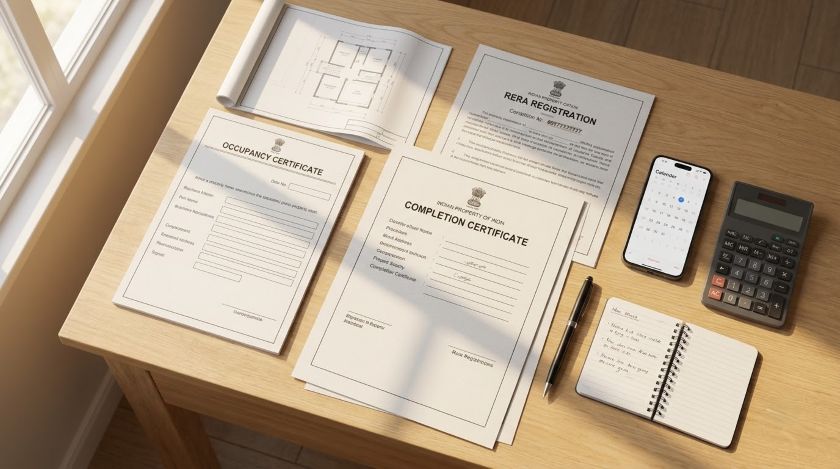 Verify RERA registration independently on your state's official portal — never rely only on builder-supplied paperwork