Tips To Safely Relocate Your Home Gym Equipment
Shifting to a new house with a treadmill, multi-gym or a set of weights, and not sure how to move them without damage or injury? Home gym equipment is heavy, awkward and easy to damage, and many people also want to know if they can do it themselves or should hire help. This guide explains how to move home gym equipment safely.
You will learn how to prepare your equipment, how to move each machine (treadmill, multi-gym, elliptical, exercise bike and weights), how to handle stairs and loading, how to set everything up again, and when it is better to hire packers and movers.
How to Prepare Gym Equipment for a Move
Do these first.
- Find the manual. If it is lost, download it from the manufacturer's website. Look for the weight in kg, the folding and locking steps, and any relocation instructions.
- Check the warranty and installation terms. Some brands expect their own technician to disassemble or reinstall certain machines. Confirm with the brand before you open any bolt.
- Measure the route at both ends. Measure each machine, folded and unfolded, against doors, corridors, stairs and the lift. Then check with your society or building about lift booking, moving timings, and whether the service lift can take heavy items.
- Clean and dry everything. Wipe the handrails and other touch points, and dry the metal parts fully. Damp parts wrapped for a few days can rust, especially in humid weather.
- Take photos before you disassemble. Photograph the wiring, cable routing and how the parts fit. You will need these during reassembly.
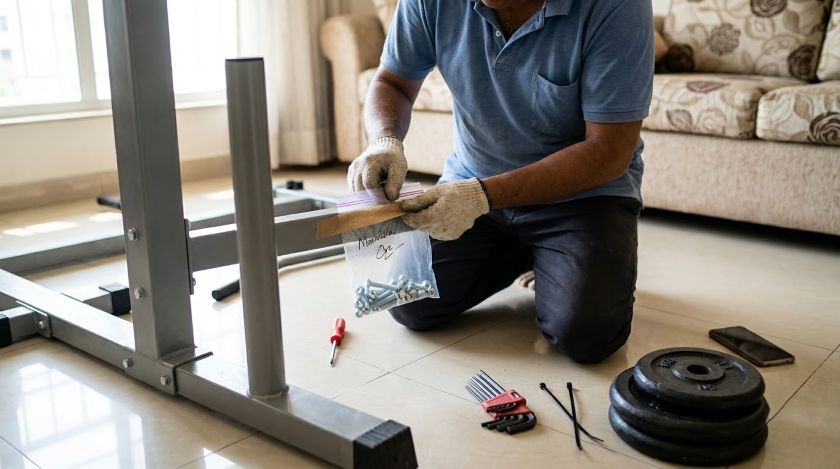
- Label the hardware. Put screws and bolts in zip-lock pouches, write the machine and part name on each, and tape the pouch to the machine. Do not drop them into a general carton.
- Keep tools and gloves ready. Screwdrivers, spanners or Allen keys, zip ties, gloves and closed shoes. Clear the path before anyone lifts.
How to Move Each Type of Home Gym Equipment
How to Move a Treadmill
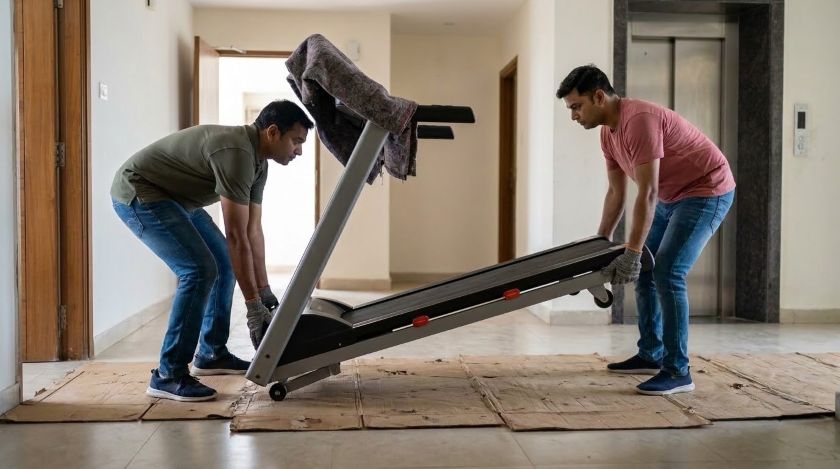
- Power down. Bring the incline to its flattest setting, switch off, unplug and remove the safety key.
- Fold and lock the deck. Most home treadmills fold with a latch or lock. Your manual will show which one. If your treadmill does not fold, follow the manual for what can be removed, and hire help if it is a large, heavy model.
- Protect the console. It is the most fragile and costly part. Cover it with foam or a thick cloth and secure it.
- Tie up the power cord so it does not trail or get trapped.
- Tilt and roll. If your model has transport wheels, tilt it back onto them and roll it.
How to Move a Multi-Gym or Weight Machine
This is the hardest machine to move, and putting the cables back is the hardest part. Use this as a general outline.
- Photograph the cable routing from a few angles before you start.
- Remove the weight plates from the stack and set them aside.
- Take off the cable attachments and handles. Release cable tension only in the way the manual describes.
- Separate the larger frame sections. Work in the order the manual gives.
- Wrap frame sections and any part that can dent or scratch in blankets or thick padding, since they will not fit in cartons.
- Tape or tie down anything that moves, such as guide rods and arms.
How to Move an Elliptical and an Exercise Bike
How to Pack Dumbbells, Plates, Barbells and Kettlebells
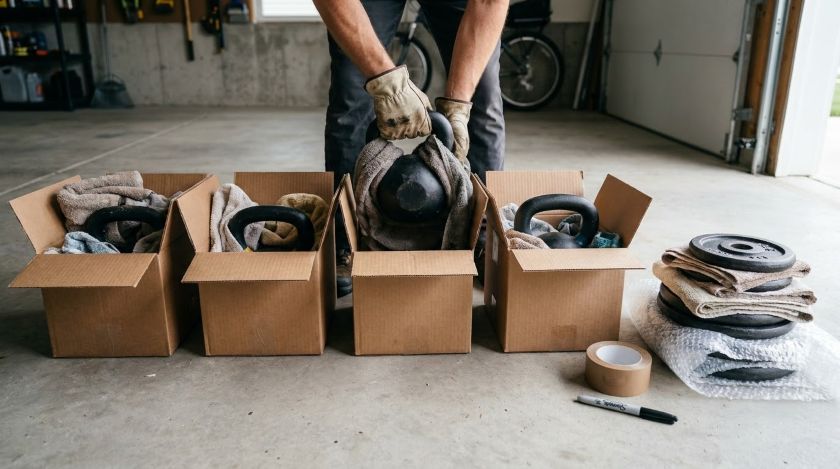
- Use several small, strong cartons or plastic bins instead of one large box. A good rule: do not fill a box beyond what you can carry comfortably up a flight of stairs.
- Put the heaviest items at the bottom of the box and fill the gaps so nothing shifts.
| Equipment | How to pack |
|---|---|
| Plates and dumbbells | Wrap plates and dumbbells in towels or bubble wrap so they do not scratch each other or the box. |
| Kettlebells | Kettlebells are dense and can break a weak box. Pack one or two per small carton or crate, packed tightly with padding. |
| Barbells | Barbells will not fit in a carton. Wrap them in a blanket or towels, tie them together and carry them flat. |
How to Move Benches, Racks and Small Gear
Take apart benches and racks where the design allows, label the hardware and pad the sharp edges. Roll up yoga mats and resistance bands, deflate exercise balls, and keep small accessories together in one box.
Moving Day: Stairs, Lifts and Loading
- Use at least two people, and three for anything heavy.
- Fold and lock the machine first, and remove any parts the manual allows, such as handles, pedals or the seat.
- Let one person give the instructions, so both people move together.
- Never stand below the machine. Rest on the landings, not in the middle of the stairs.
- Stop if the stairs are steep or narrow, or if you do not have enough people.
- A hand trolley helps on flat ground, but not on stairs.
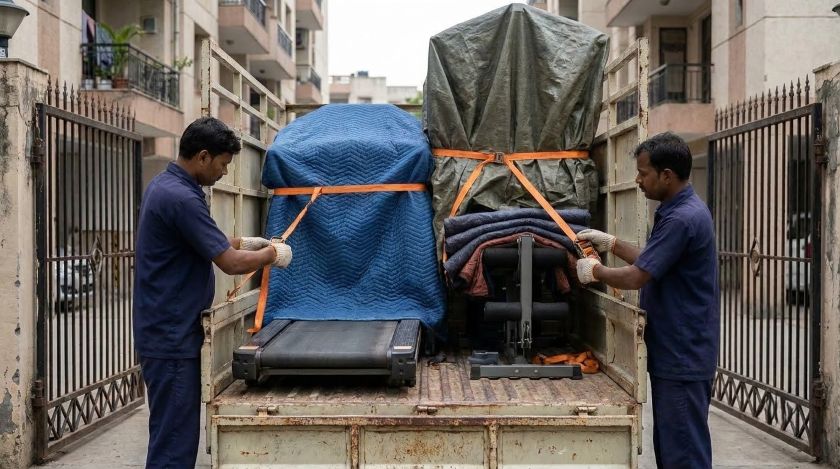
- Place heavy machines low in the tempo or mini truck, and strap them so they cannot shift.
- Keep each machine in the position its manual allows.
- Put padding between machines, and cover everything against rain and humidity.
- Keep the labelled hardware pouches with you, not loose in the vehicle.
Put cardboard or a blanket on the floor along the route, at both homes. Take corners and doorways slowly, since this is where handrails and consoles get hit.
Reassemble and Test Your Equipment at the New Home
Decide in advance where each machine will go. Check that the floor can take it, and leave the clearance the manual specifies.
- Reassemble in reverse order, using your photos and labelled pouches.
- Level the machine and tighten every fastener.
- Check the cable routing against your photos.
- Check the power socket and the machine's electrical requirements.
- Test at the lowest setting and listen for unusual noises.
| Machine | Check |
|---|---|
| Treadmill | Unfold and unlock it as the manual describes. Then check that the belt is centred and the machine is level before regular use. |
| Multi-gym | Check that the cables sit properly in the pulleys and the stack moves smoothly. |
| Elliptical | Make sure the pedals and arms are tight and move without wobble. |
When to Hire Packers and Movers for Gym Equipment
- A heavy treadmill that does not fold
- A multi-gym with a cable system
- Stairs without a lift, or a narrow stairwell
- Not enough helpers
- An expensive or under-warranty machine
- A long-distance move
- Will they disassemble and reassemble the equipment, or only carry it?
- Is damage in transit covered, and how do you claim it?
- Can they handle your access, such as stairs and your society's lift rules?
If you are comparing providers, our guide on how to verify a packers and movers company's qualifications will help you judge them, and this page explains more about hiring moving companies in India.