10 Tips for Safe Local House Shifting in Your City

Most people treat local house shifting as a half-day task. It is not — and that assumption is exactly why boxes go missing, utilities stay connected at the wrong address, and moving day turns into a full-day crisis that was entirely preventable.
The distance is shorter, but every task is identical to a long-distance move — packing, logistics, utility transfers, address updates, and finding the right local packers and movers. This guide gives you 10 expert-backed local house shifting tips that cover each of these steps in order, so you can reduce local shifting charges, protect your goods, and move without last-minute chaos.
Build an Organized Moving Checklist
A day-by-day moving checklist is the single most effective tool for keeping a local house shift on track — it converts an overwhelming list of tasks into a manageable, week-by-week plan. Without one, critical steps get missed under pressure.
| Timeframe | Key Tasks |
|---|---|
| 5–6 Weeks Before | Create master checklist · Research and book verified movers · Confirm moving date |
| 3–4 Weeks Before | Declutter room by room · Source packing materials · Notify all utility providers |
| 1–2 Weeks Before | Pack non-essentials · Confirm mover booking · Begin address updates |
| Moving Week | Pack remaining items · Finalize utility transfers · Final walkthrough of old home |
On Moving Day — What to Do
- Assign one person to supervise loading at the old home
- Assign one person to supervise unloading at the new home
- Never leave movers unsupervised with your belongings at any point
- Follow a moving day checklist and cross-check every item against your inventory list as it is loaded.
- Inspect all goods carefully for damage before signing the delivery receipt — once you sign, disputes become very difficult
Declutter Before You Pack — Not After
Decluttering 3–4 weeks before your local house shifting date is the fastest way to reduce local shifting charges — fewer items means a smaller truck, less packing material, and lower local shifting charges.
- Any item unused for over a year is a strong discard or donate candidate
- Sell good-condition items on OLX or Quikr to recover some moving costs
- Donate usable household goods to a local NGO before moving week

Use High-Quality Packing Materials
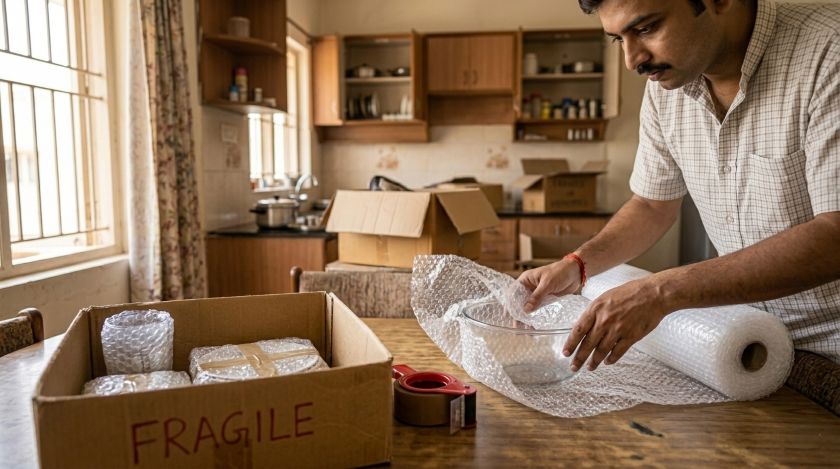
The safety of your goods during local house shifting depends almost entirely on packing quality — sturdy fiberboard boxes, bubble wrap, foam rolls, and strong sealing tape are non-negotiable, not optional extras. Even a short city drive involves loading, vibration, and unloading that will expose poorly packed items.
- Label every box: Room · Contents · Fragile where applicable
- Use clothes as wrapping for cups and glasses — minimum 2–3 layers
- Use small boxes exclusively for packing fragile items — overfilled large boxes crush contents.
- Never stack heavy boxes on top of any box marked Fragile
Create a Home Inventory List Before You Pack
Before sealing any box, photograph all valuables room by room. Note serial numbers for electronics and condition details for furniture. Save a digital copy to Google Drive or email it to yourself — accessible from anywhere on moving day.
- Cross-check every item at delivery to ensure nothing was left behind
- Provides documented evidence to support any goods-in-transit insurance claim
- Gives you a clear record if any dispute arises with your moving company
Prepare a Moving Essentials Bag
Pack one separate bag with everything you need for the first 2–3 days after the move — this bag travels with you personally and is never loaded onto the moving truck under any circumstances.
Daily Essentials
- Medication and first aid basics
- Toiletries and personal care items
- Phone and laptop chargers
- Laptop or tablet
- Change of clothes for 2–3 days
- Basic cleaning kit — broom, mop, surface cleaner
Documents Folder
- Aadhaar card and PAN card
- Passport
- Property documents (sale deed or rental agreement)
- Insurance papers — home, health, vehicle
- Bank documents
- School or college records for children
Manage Utility Services in Advance
One of the most common and costly oversights in local house shifting is failing to notify utility providers before moving day — the result is that you keep paying for services at the old address while arriving at the new home without electricity, water, or internet. Contact all providers at least 2 weeks before your moving date.
- Request a transfer if staying within the provider's service area
- Where transfer is unavailable — disconnect at old address and book reconnection at new address in advance
- Book the reconnection date immediately — walk-in requests in most Indian cities cause 3–5 day delays
- Confirm disconnection at the old address takes effect on or after moving day — not before
Prepare Your Electronics and Appliances
Every major appliance needs specific preparation before a local shifting day — an unprepared appliance is not just a risk to itself but can leak, dirty, or damage other goods packed nearby in the truck.
| Appliance | What to Do | When |
|---|---|---|
| Refrigerator | Defrost completely — residual water leaks and damages flooring and packed boxes during transit | 24 hrs before |
| AC Unit | Professional disconnection only — prevents refrigerant gas leaks during removal | 2 days before |
| Washing Machine | Clean drum inside and out thoroughly to prevent water and odour issues in transit | 1 day before |
| All Electronics | Photograph all cable connections and configurations before unplugging; use original packaging where available | Moving eve |
Update Your Address Across All Accounts
Address updates are the most commonly delayed task in any local house shifting — and the consequences run for months after the move, with financial mail, insurance documents, and important deliveries going to the wrong address. Set aside 2–3 hours during moving week specifically for this task.
Explore the New Locality Before Moving Day
A single visit to your new neighbourhood before local shifting day significantly reduces first-day stress — you arrive knowing where to find a pharmacy, how to access the building, and what the society's moving rules are, rather than discovering these under pressure.
Society Logistics — Confirm Before Moving Day
- Where does the moving truck park at the new building?
- Is elevator access available — does it need to be pre-booked with the society?
- Does the old housing society require an NOC before the truck enters the premises?
- Does the new society require a move-in notice, a deposit, or written permission?
- Are moving hours restricted? Most residential societies in Indian cities: 9am–6pm only
Stop Buying Groceries One Week Before the Move
Stop purchasing fresh groceries 7 days before your local house shifting date — this one small decision makes the kitchen the easiest room to pack and the fastest to set up at the new home, because it will be nearly empty by moving day.
Most people overlook this tip until moving day itself, when they face a full refrigerator and a packed kitchen that cannot be cleared without waste. Use the final week to cook down everything already in your pantry and fridge, planning meals around what you have rather than buying anything new.
Why This Matters on Moving Day
- An empty kitchen packs in under an hour — a full one takes half a day
- Fridges must be defrosted 24 hours before the move anyway — easier with an empty one
- Fewer kitchen boxes means lower packing cost and faster unloading at the new home
- You can prioritise setting up the kitchen first on arrival — a working kitchen reduces first-day stress immediately
Verify and Hire Trusted Local Packers and Movers
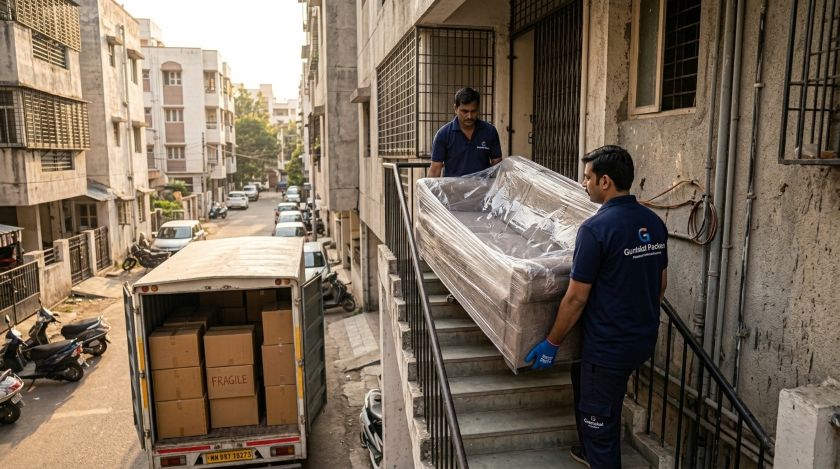
Hiring verified local packers and movers is one of the highest-impact decisions in any local house shifting — the right company makes the entire process faster, safer, and more predictable, while the wrong one creates damaged goods, unexpected charges, and missed timelines.
Always get a minimum of 3 written quotes before confirming a booking. When speaking to movers, ask specifically: What packing materials do you use? What is your estimated transit time? What is your process if goods are damaged?
Do Not Skip Goods-in-Transit Insurance
- What it is: Covers damage or loss of your belongings during the move — applicable even for short local distances, not just long-haul relocations
- Why it matters: Even experienced movers cannot prevent every accident. Without insurance, you bear the full financial cost of any damage with no recourse
- How to get it: Ask your moving company directly whether they provide goods-in-transit coverage. If not, request a third-party transit insurance quote before moving day — never after
Frequently Asked Questions About Local House Shifting
Conclusion
A smooth local house shifting is not a matter of luck — it is the direct result of preparation that begins 5–6 weeks before moving day and accounts for every detail, from the first item decluttered to the last signature on the delivery receipt. The 10 tips in this guide give you a complete, structured plan that eliminates the most common causes of local shifting problems.
Start with your checklist, declutter early to bring down local shifting charges, pack with quality materials, manage your utilities and address updates in advance, and choose your local packers and movers carefully. Each of these steps reinforces the others — a good mover is far more effective when your goods are properly packed and your inventory is documented.
Ready to Book Verified Local Packers and Movers?
Tell us your move details — city, date, and home size — and AssureShift will connect you with pre-verified movers for your house shifting service at the best rates available.