Hidden Moving Costs in India Nobody Tells You About

You've received quotes from three packers and movers for your upcoming shift from Bangalore to Mumbai. The rates seem reasonable—₹25,000, ₹28,000, and ₹30,000. You choose the lowest one, feeling smart about saving money. Moving day arrives, the truck gets loaded, and just before departure, the supervisor hands you a revised bill: ₹42,000.
Sound familiar?
This is the reality thousands of Indian families face during house shifting. The initial quote looks affordable, but the final bill tells a completely different story. These aren't just honest mistakes or miscalculations—they're hidden moving costs that most packers and movers conveniently forget to mention upfront.
In this comprehensive guide, we'll expose the hidden charges by packers and movers in India, explain why they happen, and most importantly, show you exactly how to avoid them.

- What Are "Hidden Moving Costs"?
- The Most Common Hidden Moving Costs in India
- Why Most Customers Fall for These Charges
- How to Avoid Hidden Moving Costs (Actionable Guide)
- City-Wise Cost Variations
- Real-Life Example: Cheap Quote vs Final Bill
- Why Using a Referral Platform Reduces Cost Risks
- Final Checklist: Avoid Hidden Moving Costs Like a Pro
- Conclusion
What Are "Hidden Moving Costs"?
Hidden moving costs are additional charges that appear in your final moving bill but weren't disclosed in the initial quote. These aren't legitimate expenses that arise from unforeseen circumstances—they're calculated strategies used by some moving companies to lure customers with low quotes and then add charges later when you're locked in.
The difference between a base quote and the final bill can be shocking. A quote might include only the truck rental and basic labor, while the actual service requires packing materials, floor charges, dismantling, GST, and various other "extras" that suddenly become mandatory.
Why movers don't disclose these upfront:
- To quote the lowest price and win your business
- To create pressure on moving day when you can't back out
- To exploit customers' lack of knowledge about standard charges for household shifting in India
- Because verbal quotes allow them flexibility to add charges later
Understanding the full cost structure before you book is crucial. A transparent quote should break down every component—from packing materials to vehicle size, from labor to taxes. Anything less is a red flag.
The Most Common Hidden Moving Costs in India
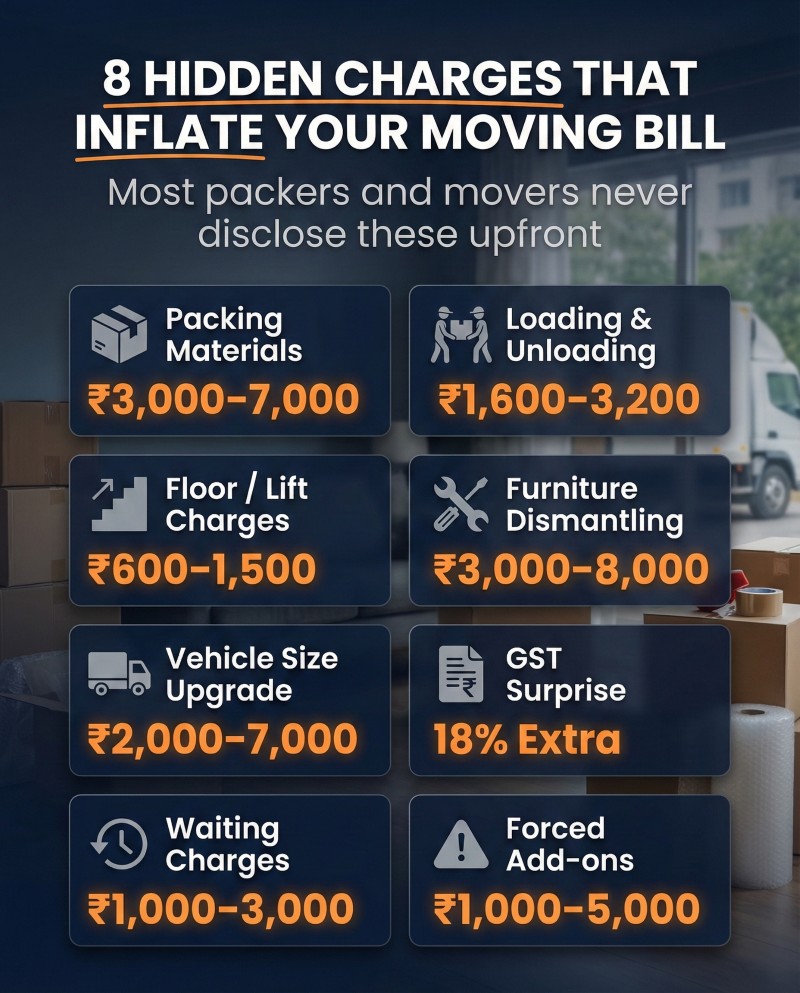
Let's break down the specific charges that catch most customers off guard. Knowing these in advance puts you in control.
1. Packing Material Charges
What it is: Bubble wrap, corrugated boxes, stretch film, packing paper, foam sheets, and thermocol used to protect your belongings during transit.
Why it appears suddenly: Many movers quote only for "labor and transport" without specifying that packing materials are extra. They'll say "packing charges included" but mean only the labor for packing, not the actual materials.
How much it usually costs:
- Bubble wrap: ₹40-60 per meter
- Corrugated boxes (various sizes): ₹30-150 per box
- Stretch film: ₹200-400 per roll
- Total material cost for a 2BHK: ₹3,000-7,000
How to avoid it:
- Ask specifically: "Are packing materials included or extra?"
- Request an itemized list of materials with quantities and rates
- Consider buying materials yourself from wholesale suppliers if movers charge excessively
- Check if used boxes are acceptable (some movers offer them at lower rates)
Many movers inflate material costs significantly. Understanding standard packing and moving charges factors helps you negotiate better rates or spot overcharging.
2. Loading & Unloading Fees
What it is: Additional charges for the manual labor required to load items onto the truck and unload them at the destination.
Why it appears suddenly: The base quote often includes only transportation, assuming you'll handle loading yourself or that "basic" loading is included—but what's "basic" is never defined.
How much it usually costs:
- Per laborer: ₹400-800 per day
- For a 2BHK: ₹1,600-3,200 (typically 4 laborers)
- Overtime charges: ₹100-200 per hour if it takes longer than expected
How to avoid it:
- Confirm in writing whether loading/unloading is included
- Ask how many laborers will be provided and for how long
- Clarify what happens if loading takes longer than estimated
- Get a fixed quote for loading/unloading, not hourly rates
3. Staircase / Lift / Carry Distance Charges
What it is: Extra fees for carrying your belongings from the parking area to your apartment door, especially in buildings without lifts or when parking is far from the entrance.
Why it appears suddenly: Movers often don't visit your home before quoting and assume easy access. When they discover you're on the 4th floor without a lift or that parking is 100 meters from your building, charges appear.
How much it usually costs:
- Per floor (without lift): ₹200-500 per floor
- Long carry distance: ₹500-1,500 if parking is far
- For a 3rd-floor apartment without lift: ₹600-1,500 extra
How to avoid it:
- Insist on a pre-move survey (physical or video-based)
- Clearly mention floor number, lift availability, and parking distance upfront
- Get written confirmation that these factors are included in the quote
- Ask about charges for narrow staircases or old building constraints
4. Furniture Dismantling & Reassembly
What it is: Taking apart beds, wardrobes, modular kitchen units, and other large furniture for safe transport, then reassembling them at your new home.
Why it appears suddenly: Many movers include "transportation of furniture" but not the carpentry work required for dismantling and assembly. This service is often outsourced to carpenters who charge separately.
How much it usually costs:
- Queen-size bed: ₹300-500 for dismantling + reassembly
- Large wardrobe: ₹400-800
- Modular kitchen: ₹2,000-5,000
- Total for a 3BHK with modular furniture: ₹3,000-8,000
How to avoid it:
- Ask explicitly: "Is dismantling and reassembly included?"
- List all furniture that needs dismantling in your quote request
- Confirm carpenter charges upfront, including both locations
- Check if you need to pay the carpenter directly or through the mover
5. Vehicle Size Upgrade Charges
What it is: Being told on moving day that your belongings won't fit in the quoted truck size and you need a larger vehicle—at a higher price.
Why it appears suddenly: Some movers deliberately underestimate the truck size needed to quote lower. Others don't conduct proper pre-move surveys. Either way, you're stuck on moving day.
How much it usually costs:
- 14-foot truck to 17-foot truck: ₹2,000-5,000 extra
- 17-foot truck to 19-foot truck: ₹3,000-7,000 extra
- Same-day vehicle arrangement premium: 20-30% additional markup
How to avoid it:
- Provide a detailed inventory list with approximate volumes
- Insist on a pre-move survey (physical or detailed video call)
- Ask the mover to confirm truck size in writing based on your inventory
- Research standard truck capacities:
- 14-foot truck: 1BHK or studio apartment
- 17-foot truck: 2BHK
- 19-foot truck: 3BHK or large 2BHK
- Get written confirmation of vehicle size as part of the contract
6. GST & Documentation Charges
What it is: Goods and Services Tax (currently 18% on moving services in India) and various "documentation fees" or "administrative charges."
Why it appears suddenly: Many movers quote prices excluding GST to appear cheaper. Some add fake documentation fees or charge GST without providing proper invoices, essentially pocketing the tax money.
How much it usually costs:
- GST: 18% of the total service value
- Fake documentation/admin charges: ₹500-2,000
- On a ₹30,000 quote: ₹5,400 in legitimate GST + potential fake charges
How to avoid it:
- Always ask: "Is this quote inclusive or exclusive of GST?"
- Request a GST invoice—legitimate movers must provide one
- Be wary of "documentation charges"—these are often not legitimate
- Understand your rights regarding GST on packers and movers
Red flag: If a mover charges you GST but doesn't provide a GST invoice with proper GSTIN details, they're likely not remitting it to the government—and you have no tax documentation for your records.
7. Waiting Charges & Delay Penalties
What it is: Hourly charges applied when movers have to wait due to traffic, society access restrictions, or delays in getting building permissions.
Why it appears suddenly: Movers quote based on ideal conditions—clear roads, immediate access, quick loading. Real-world scenarios rarely work this way, especially in metro cities.
How much it usually costs:
- Waiting charges: ₹200-500 per hour
- On a day with traffic delays or society coordination issues: ₹1,000-3,000 extra
How to avoid it:
- Ask about waiting charges upfront and get them in writing
- Understand the time window included in your quote (e.g., "4 hours loading + 6 hours transit")
- Pre-arrange building permissions and gate passes
- Schedule moves during off-peak hours when possible
- Some movers offer packages with no waiting charges—seek these out
8. Last-Minute Add-Ons & Forced Extras
What it is: "Mandatory" services that suddenly become requirements on moving day—premium insurance, special handling for electronics, cash-only payment fees, or expedited delivery charges.
Why it appears suddenly: This is pure pressure tactics. When your furniture is halfway loaded onto the truck, you're in a vulnerable position. Some unscrupulous movers exploit this with:
- "Sir, insurance is mandatory for interstate moves" (it's not)
- "Premium wrapping needed for your TV" (after you've already paid for packing)
- "Cash payment requires 5% additional charge" (not disclosed earlier)
How much it usually costs:
- Forced insurance: ₹1,000-5,000
- "Premium" handling: ₹2,000-4,000
- Cash payment surcharge: 3-5% of bill
How to avoid it:
- Get everything in writing before moving day
- Understand common moving scams in India and recognize pressure tactics
- Never agree to verbal add-ons on moving day
- If a mover refuses to proceed without unauthorized charges, document everything and consider reporting them
- Insurance should be optional and discussed upfront, never forced
Why Most Customers Fall for These Charges
Understanding why these hidden costs work is the first step to protecting yourself.
1. Moving day urgency: Once you've packed, handed over keys, or have a time-sensitive deadline, backing out becomes nearly impossible. Movers know this and use it as leverage.
2. Low-quote bait strategy: In a price-sensitive market like India, customers often choose the cheapest quote. Unscrupulous movers deliberately underbid, planning to make up the difference through hidden charges later.
3. No written cost breakdown: Verbal quotes or single-line estimates ("₹25,000 for 2BHK shifting") don't specify what's included. This ambiguity allows movers to claim "that was just for the truck" or "materials are always extra."
4. Unverified local movers: Booking random movers from Google listings or unknown brokers means no accountability. These operators often don't have proper offices, GST registration, or any reputation to protect.
5. Lack of industry knowledge: Most people shift houses only once every few years. Without experience or research, they don't know what questions to ask or what's reasonable versus exploitative.
6. Fear of confrontation: When faced with unexpected charges on moving day, many customers feel intimidated or worried about damaging their belongings if they protest. This fear keeps them compliant.
How to Avoid Hidden Moving Costs (Actionable Guide)
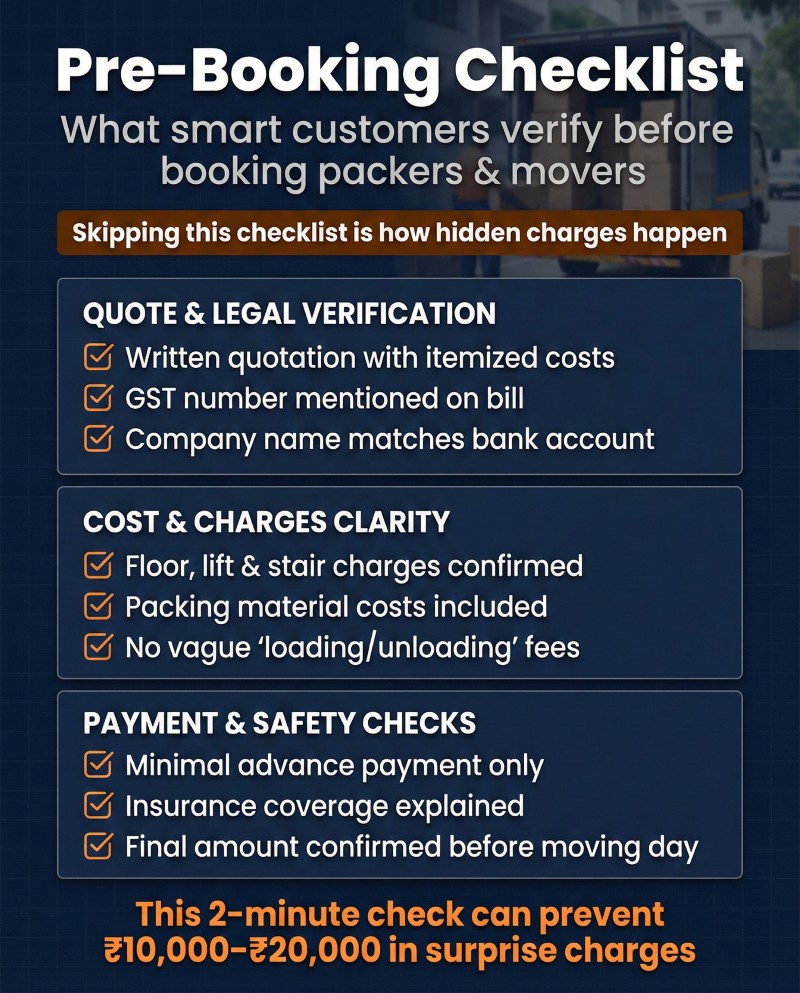
Here's your step-by-step protection plan:
1. Always Ask for a Written Cost Breakdown
Never accept a lump-sum quote. Demand an itemized breakdown showing:
Materials:
- Cardboard boxes (quantity and size)
- Bubble wrap (meters)
- Stretch film
- Tape, foam sheets, packing paper
Manpower:
- Number of laborers
- Hours included
- Loading/unloading rates
- Overtime charges
Vehicle:
- Truck size (14/17/19 feet)
- Fuel charges (included or per km)
- Distance assumed in quote
Taxes:
- GST rate and amount
- Any other statutory charges
Extras:
- Dismantling/reassembly (which items)
- Floor charges (if applicable)
- Insurance (optional, with rates)
- Waiting time policy
A legitimate mover will provide this breakdown without hesitation. If they resist, that's a massive red flag.
2. Use a Cost Calculator Before Booking
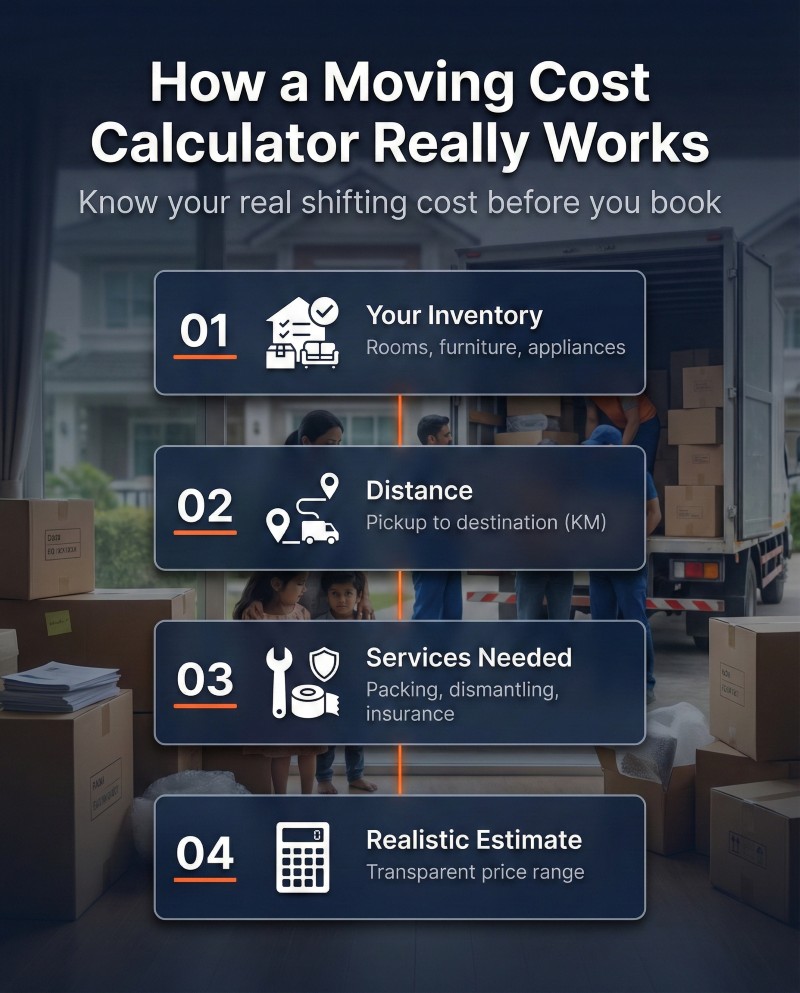
Before you even contact movers, understand the realistic price range for your move. Use a packing and moving cost calculator to get data-driven estimates based on:
- Your current and destination locations
- Number of rooms
- Approximate inventory
- Distance traveled
- Standard industry rates
This gives you a baseline to judge quotes against. If someone quotes 40% below the calculator estimate, they're either cutting corners or planning to add charges later.
Why this matters: Knowledge is power in negotiations. When you say, "Based on industry standards for a 2BHK shift from Delhi to Jaipur, the average is ₹18,000-24,000. Can you explain why your quote is significantly different?" you've established that you're an informed customer.
3. Compare Verified Movers, Not Random Google Listings
Random Google searches can lead you to:
- Broker networks with no actual moving operations
- Fake reviews and inflated ratings
- Companies operating without proper licenses
- Scam operations that disappear after taking advances
Instead, use platforms that pre-verify movers for:
- GST registration
- Business licenses and permits
- Insurance capabilities
- Customer review history
- Transparent pricing models
Explore verified house shifting services that have been screened for reliability and transparency.
What verification means:
- Physical office address confirmed
- GST number validated
- Minimum years in operation requirement
- Customer complaint history reviewed
- Transparent pricing commitment
4. Watch Out for These Red Flags
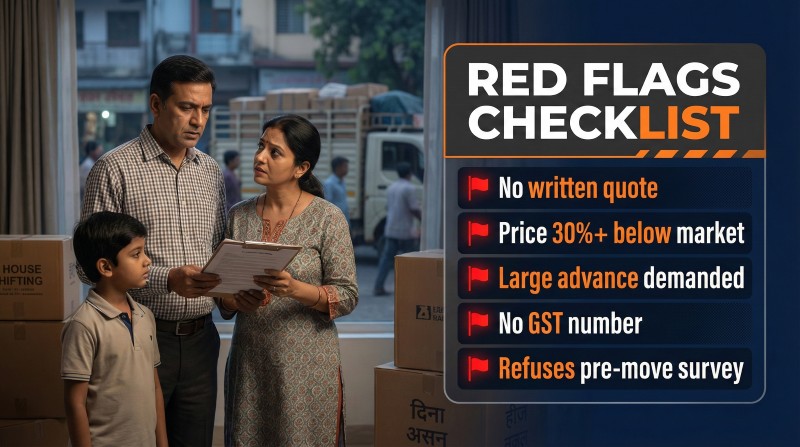
Learn to spot potential problems before you book:
Pricing red flags:
- Significantly lower than competitors (30%+ difference)
- Reluctance to provide written quotes
- Vague "all-inclusive" claims without details
- Pressure to pay large advances (50%+ upfront)
Operational red flags:
- No physical office address
- Generic mobile number instead of office line
- No website or extremely basic website
- Can't provide GST number or registration documents
- Refuses pre-move survey for interstate shifts
Communication red flags:
- Avoids putting commitments in writing
- Changes terms when you ask for documentation
- Dismisses your questions as "unnecessary worry"
- Won't explain charges clearly
Comprehensive guidance on protecting yourself: 10 Important Tips to Avoid Fraud Packers and Movers
5. Conduct a Pre-Move Survey
For any significant move (intercity or large homes), insist on a survey:
Physical survey: Mover visits your home to assess volume, access challenges, and special requirements.
Video survey: If physical isn't possible, do a detailed video call walking through each room, showing:
- All furniture and appliances
- Staircase/lift situation
- Parking distance
- Building access constraints
- Any special items (piano, aquarium, artwork)
Post-survey expectations:
- Revised quote based on actual assessment
- Written confirmation of truck size needed
- Acknowledgment of floor/access charges
- Dismantling requirements identified
6. Get Everything in Writing
Your final booking agreement should include:
- Complete itemized cost breakdown
- Vehicle size and number
- Pickup and delivery dates
- Payment schedule (never more than 10-20% advance)
- Cancellation and rescheduling policy
- Insurance terms (if opted)
- Company's GST number
- Contact details of supervisor/point person
- Complaint escalation process
Both parties should sign this agreement. Keep copies in your phone and email.
7. Document Everything on Moving Day
Protection continues through execution:
- Take photos/videos of items before packing
- Count sealed boxes and verify against inventory list
- Check truck size matches what was promised
- Get a signed inventory checklist
- Refuse to sign blank documents or bills
- Don't pay balance until delivery is complete and items are checked
City-Wise Cost Variations
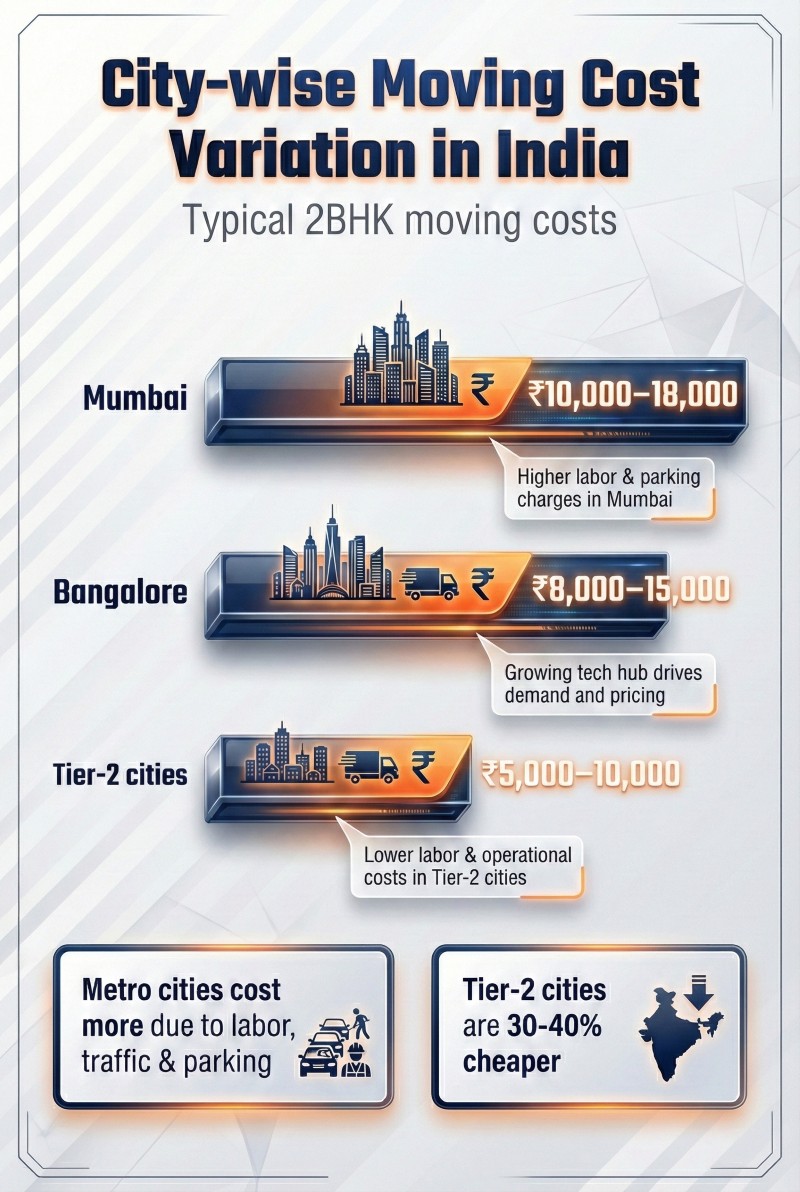
Moving costs vary significantly across Indian cities based on labor rates, distance, infrastructure, and demand patterns. Understanding these variations helps you set realistic expectations.
For example, shifting a 2BHK within Bangalore typically costs ₹8,000-15,000 for local moves (within 30km). However, the same move in a Tier-2 city might cost ₹5,000-10,000, while in Mumbai, expect ₹10,000-18,000 due to higher labor costs and access challenges.
Factors causing city-wise variations:
- Labor rates (higher in metros)
- Traffic and parking constraints (affects waiting charges)
- Building types (many Mumbai buildings have narrow stairs)
- Competition levels (more movers = better rates)
- Seasonal demand (monsoon season sees lower demand in coastal cities)
For detailed city-specific information: Packers and Movers Bangalore Charges 2025
Interstate considerations: When moving between cities, costs include fuel, driver allowances, toll taxes, and potentially multiple days of truck rental. A 1,400km move from Delhi to Bangalore for a 3BHK could cost ₹35,000-55,000 depending on exact volume and services chosen.
Real-Life Example: Cheap Quote vs Final Bill
Meet the Sharma family, relocating from Pune to Hyderabad (a 560km move) with a 2BHK apartment.
Initial Quote (Phone-Based): ₹28,000
The quote sounded reasonable, so they booked without asking for a breakdown.
Moving Day Reality:
| Item | Quoted | Actual Charge | Why It Increased |
|---|---|---|---|
| Base transport | ₹28,000 | ₹28,000 | (unchanged) |
| Packing materials | "Included" | ₹4,500 | "Labor was included, not materials" |
| Loading/unloading | "Included" | ₹2,400 | "Basic loading only, your apartment is 3rd floor" |
| Dismantling furniture | Not mentioned | ₹2,200 | "Carpenter charges extra" |
| GST @ 18% | Not mentioned | ₹6,660 | "All quotes are pre-GST" |
| Vehicle upgrade | Not mentioned | ₹3,500 | "17-ft truck too small, needed 19-ft" |
| Waiting charges | Not mentioned | ₹1,200 | "Society delayed gate pass by 2 hours" |
| Final Bill | ₹28,000 | ₹48,460 | +73% increase |
What went wrong:
- No written breakdown requested
- No pre-move survey conducted
- GST not discussed upfront
- Verbal promises about "all-inclusive" believed
- No verification of mover's credentials
What they should have done:
- Demanded itemized written quote
- Used a cost calculator for baseline (would have shown ₹35,000-45,000 range)
- Insisted on video survey for interstate move
- Compared 3-4 verified movers
- Asked specifically about GST, materials, and labor
- Got everything documented in a signed agreement
The Sharmas ended up paying ₹48,460—73% more than quoted—because they didn't know what questions to ask. Don't be the Sharmas.
Don't let this happen to you. Get transparent quotes from verified movers with zero hidden charges. Compare prices, read reviews, and book with confidence.
Don't Fall for Hidden Charges — Get Transparent Quotes Today
Connect with verified packers and movers who provide detailed written quotes with zero hidden costs. Compare prices, check reviews, and move with complete confidence.
Why Using a Referral Platform Reduces Cost Risks
Individual research and verification takes significant time and still carries risk. This is where referral platforms add value.
How platforms like AssureShift protect you:
1. Pre-Verification: Movers are screened before being listed
- GST registration confirmed
- License documentation verified
- Operating history checked
- Customer complaint patterns reviewed
- Transparent pricing commitment required
2. Transparent Pricing: You receive quotes with clear breakdowns
- Standardized quotation formats
- All charges disclosed upfront
- No hidden fees in final billing
- Price protection guarantees
3. Easy Comparison: Multiple quotes in one place
- Apples-to-apples comparison with similar inclusions
- Verified customer reviews
- Service level differences clearly marked
- Direct communication with shortlisted movers
4. Accountability: Platform oversight throughout your move
- Written agreements facilitated
- Complaint escalation support
- Payment protection mechanisms
- Performance tracking of movers
5. Post-Move Support: Assistance if issues arise
- Dispute resolution support
- Insurance claim assistance
- Damage claim processing help
This doesn't mean platforms are perfect—you still need to read agreements carefully and verify details. However, the pre-screening and accountability layer significantly reduces the risk of fraud and hidden charges compared to booking random movers from Google.
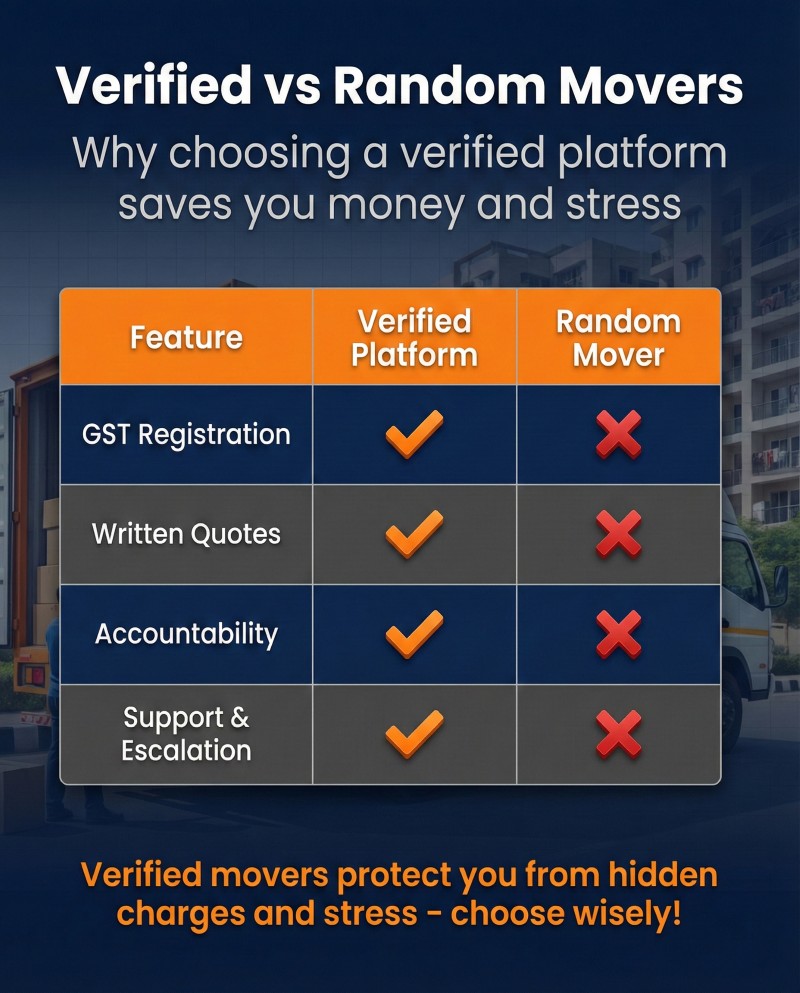
Independent verification vs platform benefits:
| Approach | Time Investment | Risk Level | Cost Transparency | Post-Move Support |
|---|---|---|---|---|
| Random Google search | Low | Very High | Poor | None |
| Self-verification | Very High | Medium | Depends on your diligence | None |
| Verified platform | Low | Low | High | Yes |
Ready to experience stress-free moving with complete cost transparency? Connect with pre-verified packers and movers who provide detailed written quotes.
Ready to Move Without Surprises?
Compare verified movers with transparent pricing, read genuine reviews, and get detailed cost breakdowns before you book. No hidden charges, no last-minute surprises.
Final Checklist: Avoid Hidden Moving Costs Like a Pro
Before you book any mover, ensure you've covered these bases:
Pre-Booking Phase:
- Used a cost calculator to understand realistic pricing
- Collected quotes from at least 3 movers
- Verified each mover's GST registration and credentials
- Requested itemized written breakdowns from all
- Compared what's included vs excluded in each quote
- Checked online reviews from multiple sources
- Confirmed truck size needed for your inventory
During Booking:
- Got pre-move survey completed (physical or video)
- Received revised quote based on actual assessment
- Confirmed all charges in writing (materials, labor, vehicle, taxes)
- Clarified GST inclusion and invoice commitment
- Discussed potential extra charges (floor charges, waiting, etc.)
- Set clear payment schedule (minimal advance, balance on completion)
- Received signed written agreement covering all terms
- Saved all WhatsApp/email communications
On Moving Day:
- Verified truck size matches agreement
- Documented item condition before packing
- Counted packed boxes against inventory list
- Refused to sign blank documents
- Questioned any charges not in written agreement
- Kept copy of inventory and bill accessible
Payment & Completion:
- Verified all items delivered before final payment
- Checked for damage and noted on delivery receipt
- Received GST invoice with proper details
- Documented any discrepancies immediately
- Kept emergency buffer of 5-10% for genuine unexpected costs
Emergency Buffer Explanation: Even with perfect planning, genuine unexpected costs can occur—e.g., building elevator breaks down, requiring stairs; severe traffic causes legitimate overtime. Budget 5-10% extra for these real scenarios, but don't let this buffer become an excuse for movers to add vague charges.
Conclusion
Hidden moving costs in India aren't an unavoidable part of relocation—they're the result of information asymmetry, lack of transparency, and sometimes deliberate exploitation. Now you know exactly what to expect, what questions to ask, and how to protect yourself.
The difference between a smooth, fairly-priced move and a stressful, overcharged experience comes down to preparation and verification. Spend time upfront understanding costs, comparing verified movers, and getting everything documented. Those few hours of research can save you thousands of rupees and significant stress.
Remember:
- A quote 30% below market rate isn't a bargain—it's a trap
- Verbal promises are worthless on moving day
- GST and materials are never optional surprises—they should be disclosed upfront
- Pre-move surveys aren't luxuries for interstate moves—they're essential
- Pressure tactics on moving day are red flags, not standard practice
Plan Your Move with Complete Cost Transparency
Get started with our cost calculator to understand your realistic budget, then connect with verified house shifting services that have been pre-screened for reliability and transparent pricing.
Your next move doesn't have to include unpleasant surprises. Armed with this knowledge, you're prepared to shift with confidence—and without hidden costs.