All You Need to Know About Relocation Allowance in India

A relocation allowance meaning, a financial assistance provided by employers to cover the expenses incurred during an employee's move to a new location for work purposes. This assistance aims to ease the financial burden of the relocation process, encompassing a range of costs from moving personal belongings to travel and temporary accommodation.
It's not just about the immediate financial aid but also about the long-term implications, particularly concerning income tax and tax exemptions. A well-informed employee can effectively plan and utilize the allowance, ensuring a smoother transition both financially and personally.
This blog aims to provide an in-depth look into everything you need to know about relocation allowances in India, from what constitutes this allowance to its impact on your taxes as of 2026, thus empowering you to make informed decisions during your career journey.
What is Relocation Allowance?
A relocation allowance is a financial benefit provided by an employer to an employee to cover the expenses incurred in the process of moving and resettling in a new location for work purposes. The primary purpose of this allowance is to acknowledge and support the employee's willingness to relocate, often involving significant changes in their personal and professional lives. Before accepting a relocation offer, it's important to understand the pros and cons of relocating for a job.
Expenses Covered Under Relocation Allowance in India
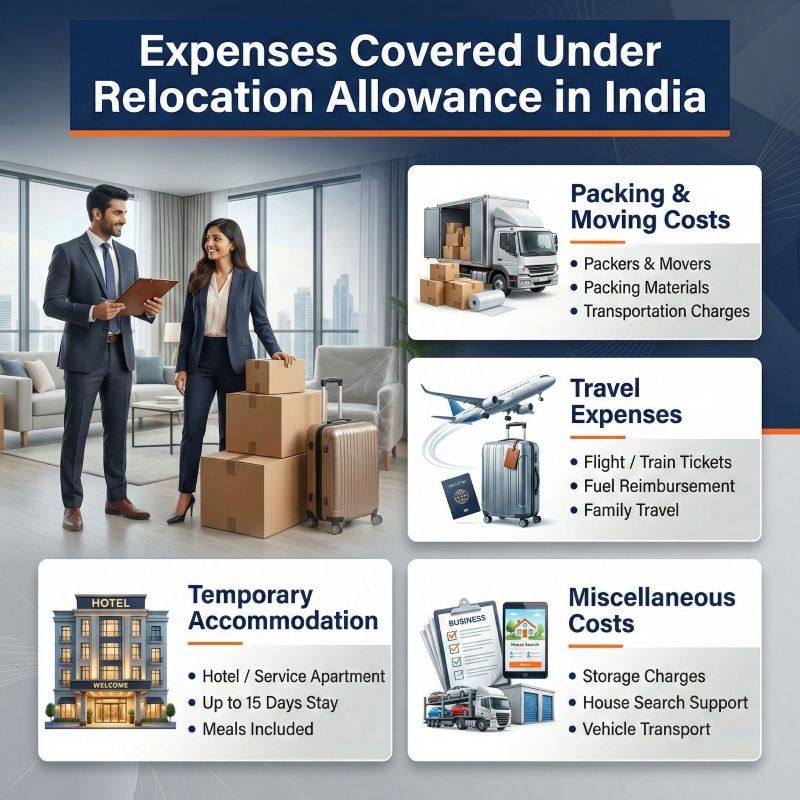
- Packing and Moving Costs: This is often the most significant expense in any relocation process. Relocation allowances usually cover the costs of hiring professional movers and packers to safely transport the employee's personal belongings from the old residence to the new one. This can include the costs of packing materials, handling charges, and the physical transportation of items.
- Temporary Accommodation: Upon arriving at the new location, employees might need temporary housing before they find a permanent residence. Relocation allowances often cover the costs of short-term rentals or hotel stays during this transitional period.
- Travel Expenses: This encompasses the cost of travel from the old location to the new one. It can include airfare, train tickets, or fuel costs if the employee is traveling by their own vehicle. Some companies also cover the cost of meals and other incidental expenses during the journey.
- Miscellaneous Expenses: Depending on company policy, the relocation allowance might also cover additional costs such as storage fees for belongings, expenses related to finding new housing (like real estate agent fees), and sometimes even the costs associated with settling into the new location, like school fees for children or language classes in case of an international move.
Understanding your relocation allowance is just one part of the moving puzzle. We know there are countless other tasks vying for your attention during this transition. Why not focus on settling into your new life and let us handle the heavy lifting?
Company Policies on Relocation Allowance in India
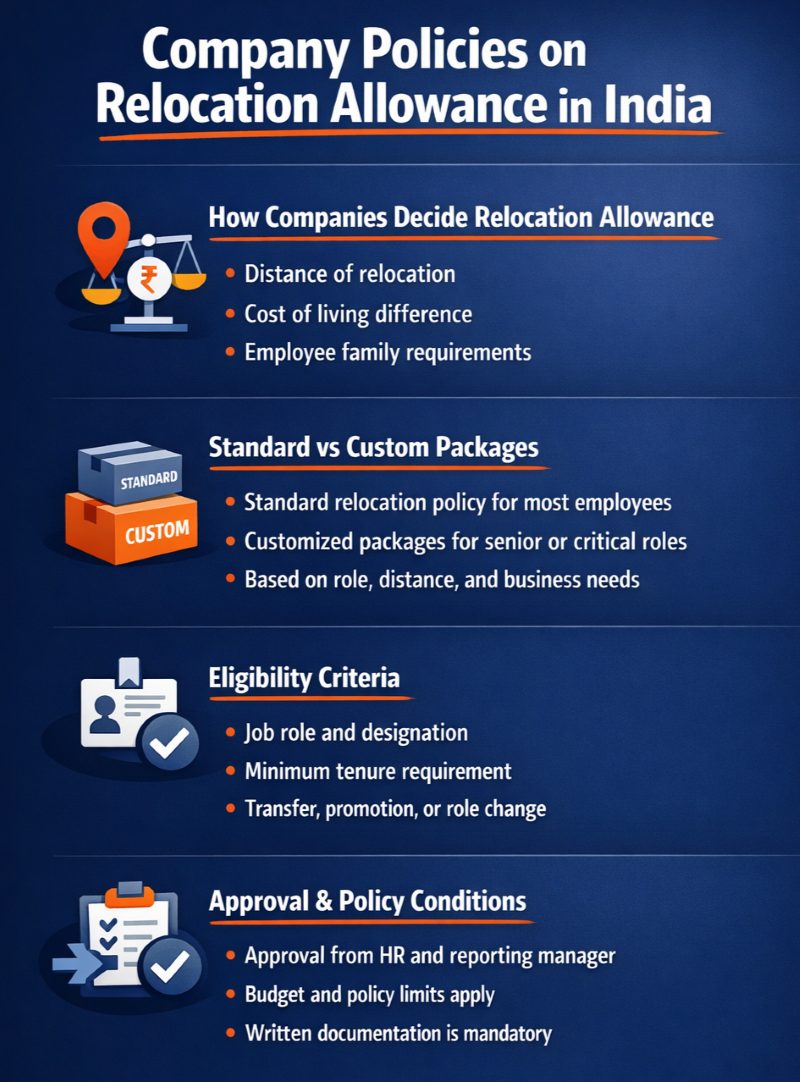
When it comes to relocation allowances, company policies can vary significantly, shaped by factors like company size, nature of the business, employee roles, and the relocation's geographical scope. Understanding how companies determine and administer these allowances is essential for employees to navigate their relocation process effectively.
Determining Relocation Allowance
- Assessment of Relocation Needs: Companies often start by assessing the specific needs of the relocation. This could be based on the distance of the move, the cost of living in the new location, and the family situation of the employee.
- Standardized vs. Customized Packages: Some companies offer standardized relocation packages that apply uniformly to all employees, while others opt for customized packages tailored to individual circumstances.
Common Policies and Conditions
- Eligibility Criteria: Policies usually specify which employees are eligible for relocation allowances, often based on factors like tenure, position, and the nature of the job transfer.
- Approval Process: The procedure to obtain approval for a relocation allowance typically involves multiple levels of management and HR, ensuring that the allowance is justified and within policy limits.
Employee Eligibility and Process for Relocation Allowance
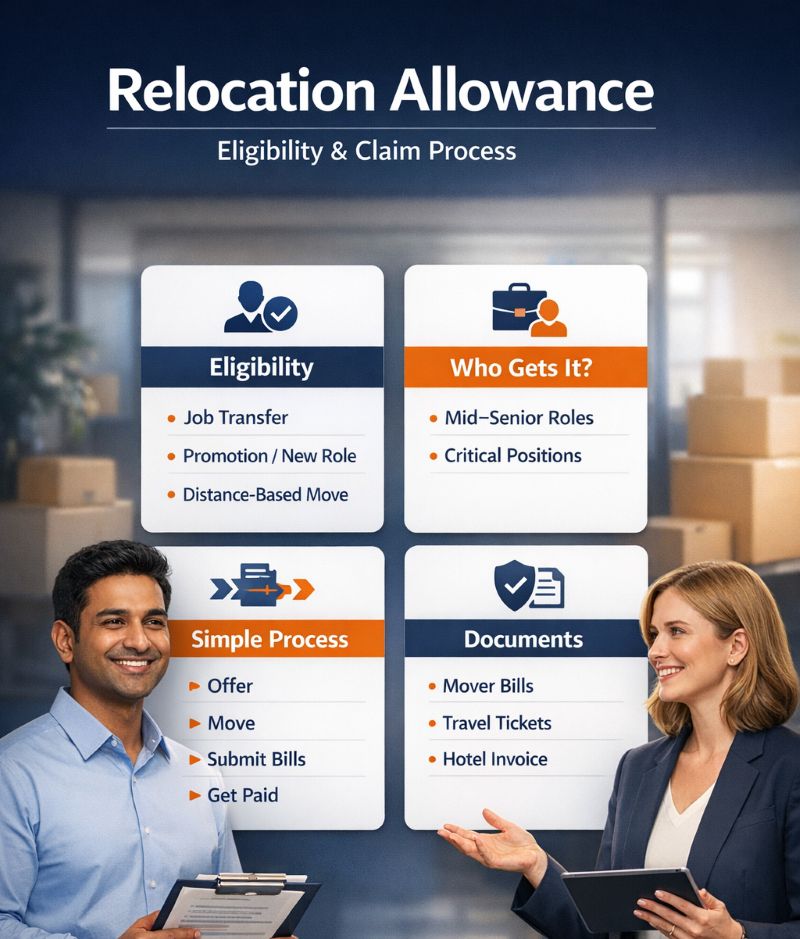
Navigating the eligibility criteria and process for claiming a relocation allowance is a critical step for employees undergoing a job-related move. Understanding these aspects ensures a smooth transition and proper utilization of the benefits offered.
Criteria for Employee Eligibility
- Job Role and Level: Often, eligibility is determined by the employee's position within the company. Higher-level employees or those in critical roles might be more likely to receive relocation benefits.
- Nature of Relocation: Eligibility can also depend on the reason for relocation, such as a transfer, promotion, or accepting a new position within the company.
- Tenure: Some companies require employees to have worked for a certain period before being eligible for relocation assistance.
- Distance of Move: There might be a minimum distance requirement for relocation to be considered eligible for the allowance.
The Process of Claiming Relocation Allowance
- Initiating the Process: The process usually starts with the employee receiving a relocation offer, which should be carefully reviewed for terms and conditions.
- Submission of a Request: Employees typically need to submit a formal request or application for the relocation allowance, outlining the expected expenses and other relevant details.
- Approval from Management: The request is then reviewed by the appropriate management or HR personnel, who will approve or deny the claim based on company policy and budget considerations.
Required Documentation and Approval Process
- Documentation of Expenses: Employees are generally required to provide detailed documentation of their relocation expenses. This includes receipts, invoices, and estimates for services like moving, travel, and temporary lodging.
- Verification and Compliance: The submitted documents are reviewed to ensure they comply with company policy and the terms of the relocation allowance.
- Reimbursement or Direct Payment: Depending on the company's policy, the allowance may be provided as a reimbursement after submission of expenses or as a direct payment to service providers.
- Tax Documentation: In some cases, employees might also need to provide tax-related documents, especially if part of the allowance is tax-exempt.
Income Tax Implications on Relocation Allowance (2026 Update)
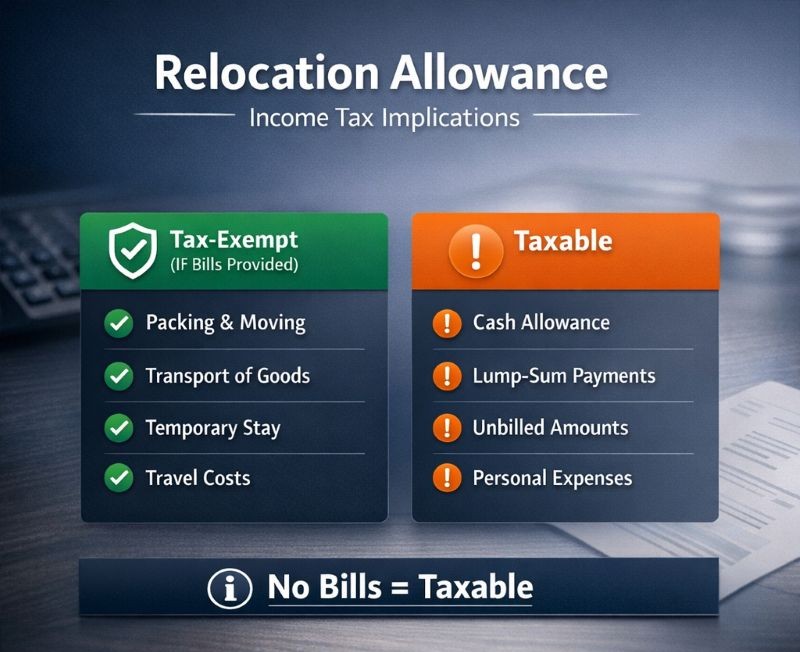
Understanding the tax implications of a relocation allowance is crucial for employees in India, as it affects the net benefit received from such allowances. The Indian Income Tax Act provides specific guidelines on how relocation allowances are treated for tax purposes.
Overview of Taxability of Relocation Allowance
- Taxable as Income: In general, relocation allowances are considered taxable income under the Indian Income Tax Act. This means that the allowance, or a portion of it, is subject to tax, similar to an employee's regular salary.
- Dependent on Actual Expenses: However, the taxability of the allowance often depends on the actual expenses incurred during the relocation. If the employee can provide proof of expenses, parts of the allowance may be exempt from tax.
- Varying Tax Rates: The tax rate applied to the relocation allowance depends on the employee's overall income slab. Therefore, the impact on an individual's tax liability will vary based on their total annual income.
Tax Exemptions under Indian Income Tax Laws
- Exemption for Specific Components: Certain components of the relocation allowance, like expenses for transporting personal effects and travel costs for the employee and their family, can qualify for tax exemptions under Section 10(14) and Rule 2BB.
- Submission of Bills and Receipts: To claim these exemptions, employees must submit relevant bills and receipts to their employer. The employer will then exclude these amounts from the taxable portion of the allowance.
- Limits on Exemption Amounts: The exempt expenses include packing and moving of household goods, travel expenses for employee and family, temporary accommodation for up to 15 days (including meals as part of boarding expenses), and vehicle re-registration charges.
Old Tax Regime vs New Tax Regime (FY 2025-26)
With the introduction of the new tax regime and its updates in Budget 2025, employees need to understand how relocation allowances are taxed under both regimes. You can use an income tax calculator to compare your tax liability under both regimes.
| Particulars | Old Tax Regime | New Tax Regime (Default) |
|---|---|---|
| Tax-Free Income | Up to ₹2.5 lakh (Below 60 years) Up to ₹3 lakh (60-80 years) Up to ₹5 lakh (Above 80 years) |
Up to ₹4 lakh (All age groups) |
| Rebate u/s 87A | ₹12,500 (Income up to ₹5 lakh) | ₹60,000 (Income up to ₹7 lakh) |
| Effective Tax-Free Income | Up to ₹5 lakh | Up to ₹12 lakh (₹12.75 lakh with standard deduction) |
| Tax Slabs | ₹2.5L-₹5L: 5% ₹5L-₹10L: 20% Above ₹10L: 30% |
₹4L-₹8L: 5% ₹8L-₹12L: 10% ₹12L-₹16L: 15% ₹16L-₹20L: 20% ₹20L-₹24L: 25% Above ₹24L: 30% |
| Standard Deduction | ₹50,000 | ₹75,000 |
| Deductions Available | 80C, 80D, 80E, 80G, 24(b), HRA, LTA, etc. | Very limited (NPS employer contribution u/s 80CCD(2), standard deduction) |
| Relocation Allowance Exemption | Available as per Section 10(14) & Rule 2BB | Available as per Section 10(14) & Rule 2BB |
| Flexibility to Switch | Can switch every year (non-business income) | Default regime; can opt out every year |
Important Note: Relocation allowance exemptions under Section 10(14) are available in both tax regimes when supported by proper documentation. The choice between regimes should be based on your overall tax planning and available deductions.
Simple Relocation Allowance Tax Calculator
Calculate Your Tax on Relocation Allowance
Tax Calculation Result
Total Allowance Received: ₹
Tax-Exempt Amount: ₹
Taxable Amount: ₹
Tax on Relocation Allowance: ₹
Calculation Examples with Current Tax Slabs (FY 2025-26)
Example 1 (New Tax Regime): An employee receives a relocation allowance of ₹1,00,000 and has actual expenses (with bills) of ₹80,000. The employee's total annual income is ₹10,00,000.
- Tax-exempt amount: ₹80,000
- Taxable amount: ₹20,000
- Tax on relocation allowance: ₹2,000 (10% slab)
Example 2 (Old Tax Regime): An employee earning ₹15,00,000 annually receives ₹50,000 as relocation allowance with no supporting bills.
- Taxable amount: ₹50,000
- Tax on relocation allowance: ₹15,000 (30% slab)
Repayment and Clawback Clauses: What You Need to Know
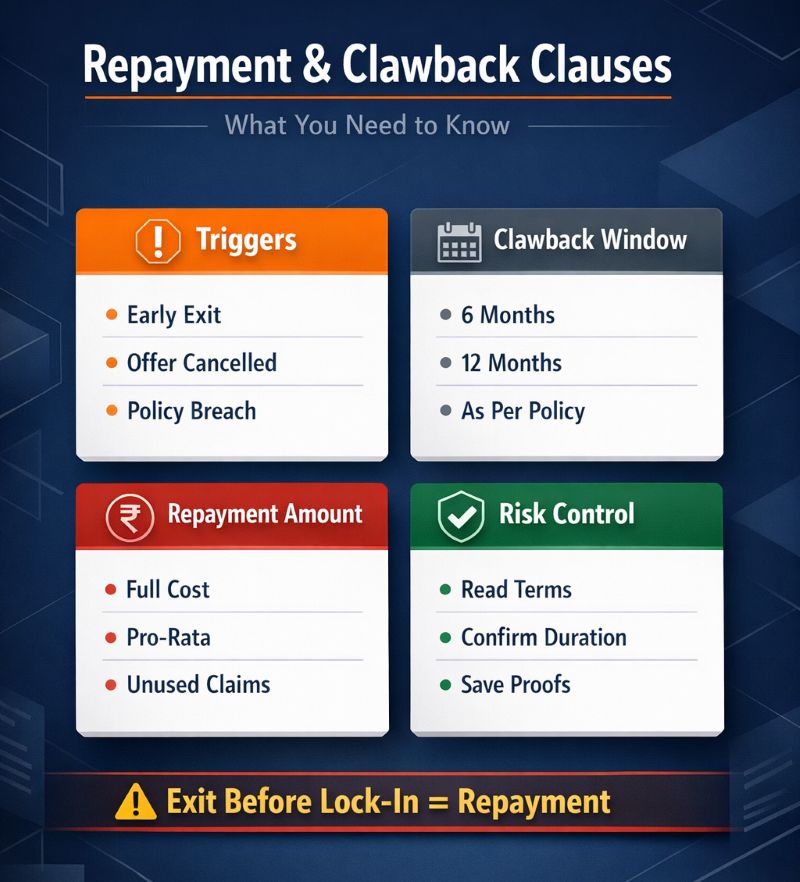
Many employees are surprised to learn that relocation allowances often come with strings attached. Understanding repayment and clawback clauses is crucial before accepting a relocation package.
What is a Relocation Repayment Clause?
A repayment clause (also called a clawback provision) requires employees to repay all or part of their relocation allowance if they leave the company within a specified period after relocating. This protects the employer's investment in your relocation.
Common Repayment Terms
- Lock-in Period: Typically ranges from 12 to 24 months. Some companies extend this to 36 months for international relocations or senior positions.
- Full vs. Prorated Repayment:
- Full Repayment: If you leave within 6-12 months, repay 100% of the allowance
- Prorated Repayment: Repayment decreases over time (e.g., 100% in first 6 months, 75% in next 6 months, 50% in next 6 months, 25% in final 6 months)
- Resignation vs. Termination: Most clauses apply only if you resign voluntarily. If the company terminates you without cause, repayment is usually waived.
- Internal Transfers: Some companies waive repayment if you transfer to another role within the same organization.
Example Repayment Schedule
| Time Since Relocation | Repayment Percentage | Example (₹1,00,000 allowance) |
|---|---|---|
| 0-6 months | 100% | ₹1,00,000 |
| 6-12 months | 75% | ₹75,000 |
| 12-18 months | 50% | ₹50,000 |
| 18-24 months | 25% | ₹25,000 |
| After 24 months | 0% | ₹0 |
Important Questions to Ask Before Accepting
- What is the exact lock-in period for repayment?
- Is repayment prorated or a flat percentage?
- What happens if I'm laid off or the company restructures?
- Does the clause apply to internal role changes?
- Will repayment be deducted from my final settlement or must I pay separately?
- Are there any exceptions or waivers to the repayment clause?
Tax Implications of Repayment
If you repay relocation allowance in a year after you received it, you may be eligible for tax relief under Section 89(1). The repaid amount was already taxed when you received it, so you can claim relief for the tax paid. Consult a tax professional to understand how to claim this relief in your Income Tax Return.
Pro Tip: Always get the repayment terms in writing as part of your offer letter or relocation policy document. Verbal assurances are not legally binding.
Common Mistakes to Avoid with Relocation Allowance
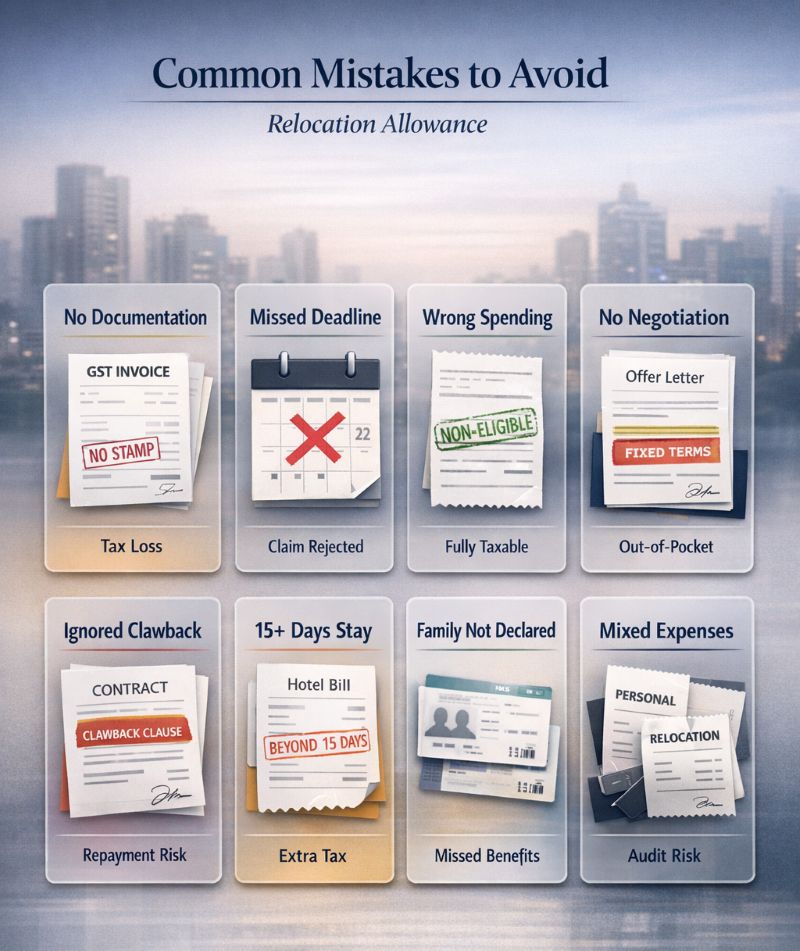
Even with the best intentions, employees often make costly mistakes when managing their relocation allowance. Here are the most common pitfalls and how to avoid them:
1. Not Keeping Proper Documentation
The Mistake: Failing to collect and maintain bills, receipts, and invoices for all relocation expenses.
The Impact: Without proper documentation, you lose tax exemption benefits, meaning the entire allowance becomes taxable. This can result in thousands of rupees in additional tax.
How to Avoid: Create a dedicated folder (physical and digital) for all relocation receipts. Take photos of bills immediately and organize them by category (moving, travel, accommodation). Ensure bills are in your name or family members' names.
2. Missing Claim Deadlines
The Mistake: Not submitting your relocation expense claim within the company's specified timeframe.
The Impact: Most companies have strict deadlines (typically 30-90 days post-relocation). Missing these means forfeiting your reimbursement rights.
How to Avoid: Submit your claim as soon as possible after relocation. Don't wait until you've "settled in completely." Set a reminder for yourself 2 weeks before the deadline.
3. Spending on Non-Eligible Expenses
The Mistake: Using the allowance for expenses that don't qualify for tax exemption, such as:
- New furniture purchases
- School admission fees (beyond transfer certificates)
- House brokerage or rental deposits
- Utility connection fees
- Tourism or sightseeing during the move
The Impact: These expenses are fully taxable, reducing the effective value of your allowance.
How to Avoid: Review your company's policy and Section 10(14) exemptions before spending. Prioritize eligible expenses first.
4. Not Negotiating the Package
The Mistake: Accepting the first relocation offer without discussing your actual needs or specific circumstances.
The Impact: You may end up covering significant out-of-pocket expenses that could have been included in the package.
How to Avoid: Research typical packages for your level and industry. Present a realistic estimate of your relocation costs during negotiation. Don't be afraid to ask for specific inclusions like family travel or extended temporary housing.
5. Ignoring the Repayment Clause
The Mistake: Not reading or understanding the repayment terms before accepting the relocation.
The Impact: If you need to leave the company within the lock-in period, you could owe substantial amounts (sometimes the full allowance plus interest).
How to Avoid: Read your offer letter and relocation agreement carefully. Factor in the lock-in period when making career decisions. If unsure about job stability, negotiate for shorter lock-in periods or prorated repayment.
6. Exceeding the 15-Day Temporary Accommodation Limit
The Mistake: Staying in temporary accommodation (hotels, service apartments) for longer than 15 days and expecting full tax exemption.
The Impact: Only the first 15 days of temporary stay are tax-exempt. Additional days become taxable.
How to Avoid: Plan your permanent accommodation search before relocating. If you need more time, consider staying with friends/relatives after 15 days, or budget for the additional tax on extended stays.
7. Not Informing About Family Relocation
The Mistake: Not mentioning that your family will also be relocating, or assuming their expenses are automatically covered.
The Impact: You may miss out on additional allowances for spouse and children's travel, or face claim rejections later.
How to Avoid: Clearly communicate your family situation during the relocation discussion. Get written confirmation of what's covered for family members.
8. Mixing Personal and Relocation Expenses
The Mistake: Combining a vacation with your relocation trip or buying personal items along with household goods.
The Impact: Tax authorities or your employer may reject mixed expenses, and you lose exemption on legitimate costs.
How to Avoid: Keep relocation travel separate from personal trips. Get separate invoices for household items versus personal purchases. Maintain a clear paper trail.
Quick Checklist to Avoid Mistakes
- Read the complete relocation policy before accepting
- Get all terms in writing (allowance amount, coverage, deadlines, repayment clause)
- Create a relocation budget before spending
- Collect bills for every expense, immediately
- Submit claims well before the deadline
- Keep digital and physical copies of all documents for 6+ years
- Consult HR if any expense eligibility is unclear
- Consider hiring professional movers for better documentation
Frequently Asked Questions (FAQs)
1. What is relocation allowance in India?
Relocation allowance is a financial benefit provided by employers to employees who need to move to a new location for work purposes. It covers expenses like packing, moving, travel, and temporary accommodation.
2. Is relocation allowance taxable in India?
Relocation allowance is partially taxable. The portion used for actual relocation expenses (with proper bills) is tax-exempt under Section 10(14). Any amount exceeding actual expenses or without supporting documentation is taxable as salary income.
3. Which expenses are exempt from tax under relocation allowance?
Tax-exempt expenses include: packing and moving of household goods, travel expenses for employee and family, temporary accommodation for up to 15 days (including meals), and vehicle re-registration charges. Proper bills and receipts must be submitted.
4. Which relocation expenses are taxable?
Expenses like school admission fees, brokerage for rented house, furniture purchases, utility setup costs, and any allowance amount without supporting documentation are considered taxable income.
5. Can I claim relocation allowance exemption under the new tax regime?
Yes, relocation allowance exemptions under Section 10(14) are available in both old and new tax regimes for FY 2025-26, provided you have proper documentation of eligible expenses.
6. How much relocation allowance is typically provided in India?
Relocation allowance varies by company, employee level, distance, and relocation type. Typically, it ranges from ₹50,000 to ₹3,00,000, with senior positions and international relocations receiving higher amounts.
7. What documents are required to claim tax exemption on relocation allowance?
You need to submit: receipts from packers and movers, travel tickets (air/train), hotel bills for temporary stay, vehicle transportation bills, and re-registration receipts. All bills should be in your name or your family members' names.
8. Is there a time limit for temporary accommodation expenses?
Yes, temporary accommodation expenses (including boarding and lodging with meals) are exempt for up to 15 days from the date of relocation as per tax rules.
9. Can I negotiate my relocation package with my employer?
Yes, relocation packages are often negotiable, especially for senior positions or unique circumstances. You can discuss coverage of specific expenses, timing, and amount with your employer during the offer stage.
10. What is the difference between relocation allowance and relocation bonus?
Relocation allowance is reimbursement for actual moving expenses (partially tax-exempt with bills), while relocation bonus is a lump-sum payment that is fully taxable as income without requiring expense proof.
11. How do I report relocation allowance in my Income Tax Return (ITR)?
Include the exempt amount under "Allowances exempt u/s 10" in your salary details. The taxable portion will already be included in your Form 16. Maintain all supporting documents for at least 6 years in case of scrutiny.
12. Are international relocation expenses treated differently?
The same tax exemption rules apply, but international relocations typically involve higher costs. Additional expenses like visa fees, immigration charges, and language training may be taxable unless specifically covered under company policy as reimbursable relocation expenses.
13. Do I have to repay the relocation allowance if I leave the company?
Most companies include a repayment clause (also called clawback provision) in their relocation policy. If you resign within a specified lock-in period (typically 12-24 months), you may need to repay all or part of the allowance. Repayment is often prorated—for example, 100% if you leave within 6 months, reducing gradually over time. However, if the company terminates you without cause (layoffs, restructuring), repayment is usually waived. Always read your offer letter or relocation agreement carefully for specific terms before accepting.
14. What are the biggest mistakes people make with relocation allowances?
The most common mistakes include: (1) Not keeping proper bills and receipts, which results in losing tax exemption benefits; (2) Missing company claim deadlines, leading to forfeiture of reimbursement; (3) Spending on non-eligible expenses like furniture or school admission fees that are fully taxable; (4) Exceeding the 15-day temporary accommodation limit without budgeting for additional tax; and (5) Not reading the repayment clause before accepting. To avoid these, maintain organized documentation, submit claims promptly, and understand both tax rules and company policy upfront.
15. Can I negotiate my relocation package, and if so, how?
Yes, relocation packages are often negotiable, especially for senior roles, specialized positions, or long-distance moves. The best time to negotiate is during the offer stage, before you accept. Calculate your actual expected costs (get quotes from movers, check flight prices, research accommodation), then present a professional case with specific numbers. Negotiable items typically include the total allowance amount, temporary housing duration, family travel coverage, and house-hunting trips. If direct allowance increases aren't possible, consider requesting a joining bonus, higher base salary, or extended temporary accommodation instead.
16. What documentation should I keep and for how long after receiving relocation allowance?
Maintain all original bills, receipts, and invoices for packing and moving services, travel tickets, hotel stays, vehicle transportation, and any other claimed expenses. Keep both physical copies and digital scans in an organized folder. You must retain these documents for at least 6 years from the end of the financial year in which you received the allowance—this is the standard scrutiny period for tax authorities. Proper documentation is essential not just for claiming reimbursement from your employer, but also for proving tax exemptions if your return is ever audited.
Navigating Your Relocation Allowance Journey: Key Takeaways and Expert Advice
Relocating for work is a significant event that comes with its set of challenges and opportunities. Through this comprehensive guide, we've explored the various facets of relocation allowances in India, offering insights to help you navigate this transition effectively.
As you embark on your relocation journey, it is crucial to remember that each situation is unique. The policies of different companies, the specifics of individual relocation circumstances, and the ever-evolving tax regulations make it imperative to seek personalized guidance.
Relocating is not just about moving to a new place; it's about transitioning to a new phase in your professional life. With the right information and support of professional house shifting services, this journey can be managed smoothly, allowing you to focus on the exciting opportunities that lie ahead in your career. For a comprehensive understanding of the entire process, check out our detailed relocating for work guide.
Ready to make your work relocation stress-free? Share your moving requirements and get instant quotes from verified packers and movers.
Disclaimer: This article is for informational purposes only and should not be considered as professional tax advice. Tax laws are subject to change, and individual circumstances vary. Please consult with a qualified tax professional or chartered accountant for personalized tax planning advice.